Mushroom Greenhouse Cultivation Methods and Key Technical Points
How to grow mushrooms in a greenhouse? You can refer to the following methods for greenhouse mushroom cultivation: Greenhouse mushroom cultivation technique - composting and fermentation. 1. Outdoor pre-fermentation: 2 days before building the pile, cut the rice straw into 2 segments and pre-wet it, watering while turning; the straw pile should not be too thick, and the middle and lower parts must be thoroughly wet. 3 to 4 days before building the pile...
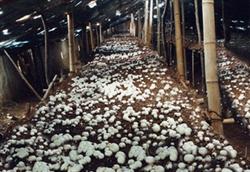
How to grow mushrooms in a greenhouse? Please see the introduction
Greenhouse mushroom cultivation can be carried out by referring to the following methods:
Greenhouse mushroom cultivation technique - composting and fermentation
1. Outdoor pre-fermentation: 2 days before building the pile, cut the rice straw into 2 segments and pre-wet it, watering while turning; the straw pile should not be too thick, and the middle and lower parts must be thoroughly wet. 3 to 4 days before building the pile, pile up the ingredients in the formula (except lime and urea), control the moisture at about 55%, and turn the pile once in the middle. 1 day before building the pile, spray 0.5% dichlorvos solution on the mixed material, then cover with film for 12 to 24 hours. Build the pile according to conventional practice, with turning intervals of 5, 4, and 3 days, adding urea and lime when turning. Keep the water content at 65% to 70% and the pH at 7.5 to 8.
2. Indoor post-fermentation: After loosening the material, transport it with a dump truck onto the bed frames (do not place it on the bottom layer of the frames), heat with a coal stove or diesel drum steam stove, and when the material temperature rises to 60 to 62°C, maintain it for 6 to 8 hours; ventilate appropriately, and when the material temperature drops to 48 to 52°C, maintain it for 4 to 5 days. After post-fermentation ends, the material is dark coffee-colored, very soft, the rice straw is elastic, it does not stick to the hand when squeezed, there is no ammonia smell, there is a relatively strong fragrance, and a large amount of actinomycetes is produced; the material water content is 65% and the pH is 7.2 to 7.5.
Greenhouse mushroom cultivation technique - turning the bed and sowing
When turning the pile, be sure to control the temperature well. When the material temperature drops to 28°C, turn the pile promptly. The material thickness is 18 to 20 cm, and the upper layer can be slightly thinner; level the bed surface. Broadcast spawn with wheat grain spawn at 1 bottle/sq m, pat lightly so that the spawn and material fully contact each other, and cover the areas on both sides near the door with wet newspaper. If you want to master greenhouse mushroom cultivation techniques well, this step is very important.
Greenhouse mushroom cultivation technique - post-sowing management and casing soil
After sowing, adjust the air and humidity in the greenhouse so that they suit mushroom growth. In 7 to 10 days, the mycelium basically covers the surface; after that, increase ventilation and open the doors day and night. Generally, 20 days after sowing, the mycelium reaches the bottom.
The casing soil material is rice husk mixed soil. 10 days before casing, prepare 3500 to 4000 kg of mud per 111 sq m, with a mud-to-husk ratio of 1:24, 100 to 170 kg of dry rice husk, and 50 kg of lime. Spread the rice husk and lime on open ground according to the ratio, then crush with a medium-sized tractor until the particles are a little larger than soybeans, sieve, and after piling in ridges, disinfect with formaldehyde. The casing soil thickness is 3.5 to 4 cm. After casing, immediately spray water to adjust moisture to a saturated state. If you want to master greenhouse mushroom cultivation techniques well, you must control the temperature in the greenhouse and the thickness of the casing soil, so as to ensure the quality of the mushrooms.
Click to get more mushroom cultivation techniques
Click to get more edible fungus cultivation techniques