How can greenhouse cultivation of button mushrooms achieve high yields?
How can greenhouse-grown button mushrooms achieve high yields? Please advise. The button mushroom (Agaricus bisporus) is the earliest cultivated, largest in area, and most produced global edible fungus in the world today. Button mushrooms have thick, tender flesh, are rich in nutrients, and taste excellent. At the same time, button mushrooms are an agricultural and sideline product that is exported in large quantities. -- Material preparation 1. Raw materials and...
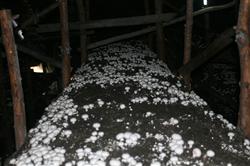
How can greenhouse-grown button mushrooms achieve high yields? Please advise
The button mushroom (Agaricus bisporus) is the earliest cultivated, largest in area, and most produced global edible fungus in the world today. Button mushrooms have thick, tender flesh, are rich in nutrients, and taste excellent. At the same time, button mushrooms are an agricultural and sideline product that is exported in large quantities.
-- Material preparation 1. Raw materials and ratios. Rice straw 35 kg, cow manure 11.5 kg, urea 0.35 kg, superphosphate 11.5 kg, lime 1 kg; late rice straw 43 kg, rapeseed cake 2.85 kg, urea 0.6 kg, ammonium bicarbonate 0.20 kg, gypsum powder 1.45 kg, lime 1.05 kg.
2. Area and material quantity. For building a 1000 sq m greenhouse, the material quantities are rice straw 12,500 kg, cow manure 4,000 kg, superphosphate 4,000 kg, urea 120 kg, lime 350 kg.
-- Composting To increase yields, the compost must undergo composting fermentation and heating disinfection after being brought into the greenhouse (also called secondary fermentation).
1. Composting and fermentation (called primary fermentation). Its process: washing straw (pre-wetting raw materials) -> building the pile -> turning the pile.
Straw washing -- shake the straw loose, continuously pour and splash water into the straw pile, soak the straw thoroughly, and leave it in a false pile for 2-4 days. During the false piling process, water must be frequently poured or splashed into the pile to achieve the pre-wetting purpose.
When building the pile, add materials layer by layer in the order of straw first, then cow manure (or cake), building it higher as you go. The pile width is 1.6-2 m, height 1.6-1.8 m, and the pile length depends on the site; after building the pile, a small amount of water should seep out from inside the pile. After building the pile, cover it with straw mats in sunny weather and with plastic film in rainy weather to prevent rainwater from leaching in; after rain, remove the film promptly to ventilate. Turning should be done when the temperature inside the pile first reaches its highest point and then begins to drop. The entire composting process involves three turnings: carried out according to 5-4-3 days: at the first turning, add the remaining 50% of the total urea, compound fertilizer and superphosphate, and add all the gypsum used; the second turning is carried out 4 days after the first turning, and at the same time add 45% of the total lime; the third turning is carried out 3 days after the second turning.
2. Bringing into the greenhouse and disinfection (called secondary fermentation). Secondary fermentation is the process of moving the primary-fermented compost into the mushroom house, stacking it on the shelf tiers, heating the greenhouse with a carbon stove or steam, raising the greenhouse temperature to 57-60°C over 1-2 days, maintaining it for 10 hours, then lowering it to 48-52°C and maintaining that for 3-4 days.
Click to get more mushroom cultivation techniques
Click to get more edible fungus cultivation techniques