How is lion's mane mushroom cultivated in plastic greenhouses?
How is lion's mane mushroom cultivated in plastic greenhouses? Please explain. Lion's mane mushroom (Hericium erinaceus) is a mid-to-high-grade edible fungus with a distinctive flavor and high nutritional and health value. As people's living standards improve, the market for fresh lion's mane mushroom is gradually expanding. Popularizing lion's mane mushroom cultivation can both meet people's consumer needs and help mushroom farmers...
How is lion's mane mushroom cultivated in plastic greenhouses? Please explain.
Lion's mane mushroom (Hericium erinaceus) is a mid-to-high-grade edible fungus with a distinctive flavor and high nutritional and health value. As people's living standards improve, the market for fresh lion's mane mushroom is gradually expanding. Popularizing lion's mane mushroom cultivation can both meet people's consumer needs and help mushroom farmers get rich. The technique is described below:
I. Construction of the plastic greenhouse
Choose a flat site close to a water source and in a clean environment to build the greenhouse. Greenhouse specifications: about 45 m long from east to west (determined by the scale of cultivation), 8 m wide from north to south, north wall 2.8 m high (including the dug-down depth), south wall 1.6 m high, with a partition wall every 15 m from north to south. The walls are brick; the north wall is a double-layer hollow wall to aid heat retention; the south wall has two windows every 3 m for ventilation. The ground inside the greenhouse is dug down 50 cm, and the roof is covered with anti-drip film for heat retention. Mushroom farmers with the means can also use winter-warm vegetable greenhouses to cultivate lion's mane mushroom.
II. Cultivation season
According to the temperature requirements for the growth and development of lion's mane mushroom, when cultivating in plastic greenhouses in Shandong, cultivation bags are generally made in mid-October, and after about one month of incubation, fruiting begins in mid-to-late November and ends in early-to-mid March of the following year.
III. Preparation of cultivation bags
1. Preparation of the substrate Formula ①: 90% cottonseed hulls, 8% wheat bran, 1% gypsum, 1% superphosphate. Formula ②: 58% cottonseed hulls, 30% mixed sawdust, 10% wheat bran, 1% gypsum, 1% superphosphate. Formula ③: 50% cottonseed hulls, 38% corncob powder, 10% wheat bran, 1% gypsum, 1% superphosphate. Mix the ingredients of each formula evenly, add water at a material-to-water ratio of 1:1.2 to 1:1.4, and adjust to a moisture content of 65%.
2. Bagging Use polypropylene plastic bags of 15 cm x 32 cm to 34 cm x 0.04 cm, filling each bag with about 0.4 kg to 0.45 kg of dry material. Press the material moderately firm, then tie the bag mouth tightly with string.
IV. Sterilization
1. Atmospheric-pressure sterilization Place the substrate bags in layers in a sterilization pot, heat to 100°C, hold for 10 hours, stop the fire and let them stew for 5 to 6 hours, then take out the bags to cool and inoculate.
2. High-pressure sterilization Use a large-capacity high-pressure sterilization pot, also placing the bags in layers, maintain a pressure of 1.2 kg/sq cm for 2 hours, then let it cool naturally until the pressure is zero, open the pot lid and take out the bags to cool. When sterilizing in a large-capacity pot, if the pressure is raised to 1.5 kg/sq cm, bag melting and bag swelling are prone to occur, affecting the sterilization effect.
V. Inoculation and incubation
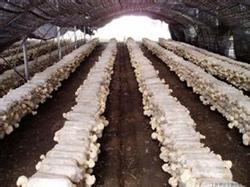
When the substrate bags have cooled to below 30°C, move them into an inoculation box for inoculation; the inoculation box is fumigated and sterilized with potassium permanganate and formaldehyde, and inoculation is carried out aseptically after 20 minutes. Inoculation is done from both ends of the substrate bag; generally each bottle of spawn can inoculate 25 bags. After inoculation, the substrate bags can be moved directly into the greenhouse for incubation and mycelial growth. Before moving them in, the greenhouse should be fully disinfected: open the windows to lower the temperature inside, spray the ground and the four walls with limewater, then fumigate tightly with formaldehyde or sulfur for 24 hours. If a winter-warm vegetable greenhouse is used to cultivate lion's mane mushroom, the inoculated substrate bags can first be placed separately in an incubation room until the mycelium has grown about 2 cm deep into the substrate, then moved into the greenhouse to continue incubation. The substrate bags are arranged in wall style, stacked 6 layers per row, with a layer of bricks on the bottom, and 60 cm between rows for easy management.
During the incubation period for mycelial growth, ventilation management should be strengthened, and straw curtains should be suitably added on the greenhouse roof for shade, keeping the temperature inside the greenhouse no higher than 27°C. After about 30 days, when the mycelium is nearly fully grown, turn the bags and inspect them, remove the bags with relatively serious contamination by foreign fungi, and the vigorously growing bags can then be managed for fruiting.
VI. Fruiting management
Untie the string at both ends of the bags whose mycelium has fully grown, gently pull the bag mouth and then immediately put it back, to improve the air exchange conditions inside the bag. Raise the humidity inside the greenhouse to above 85%, and keep the temperature inside the greenhouse at 10°C to 20°C. After late November, the warming strength of sunlight in northern regions noticeably weakens; during the day the straw curtains can be suitably removed to increase sunlight and warming, and at night the straw curtains are put on for heat retention. If the light is strong and the temperature inside the greenhouse is on the high side, straw curtains can be suitably added during the day for shade. In clear and warm weather, open the south windows slightly for moderate ventilation. Generally after 7 to 10 days, pinheads begin to appear, and after a further 10 to 15 days, when the spines of the lion's mane mushroom fruiting body are about 0.5 cm to 1 cm long, it should be harvested in good time. After harvesting, remove the mushroom base and continue cultivation. In the severe winter season, if the greenhouse's heat retention is poor, fruiting management can be suspended, and management resumed after the temperature rises in early February. Generally 2 to 3 flushes of mushrooms can be harvested, and the biological efficiency can reach 100%. Because the greenhouse has good heat retention, evaporation inside the greenhouse in winter is low, so the number of waterings should be suitably reduced during management, and spraying water on the bag mouths and mushroom buds is strictly prohibited to avoid causing the mushroom buds to rot.
For bags that have produced 2 to 3 flushes of mushrooms, the method of bed cultivation with soil casing can be used, and the biological efficiency can generally exceed 120%. The method is: dig a bed 1.2 m wide and 25 cm deep inside the greenhouse, remove the plastic bags from the substrate bags, place 3 to 4 of them as a bundle upright in the bed, cover with about 2 cm of fine loam soil, water thoroughly, and thereafter keep the bed in a moist state. After about 15 days, one flush of mushrooms can be produced, and the larger fruiting bodies can reach more than 25 cm in diameter. When the spines reach 0.5 cm long, they can be carefully harvested; cut off with a knife the part of the mushroom stem that has soil stuck to it, and it can then be sold or processed.
Using this method, the fruiting period can be extended to mid-to-late April. This method can also be used for the cultivation of lion's mane mushroom bags that have not yet fruited, and the yield-increasing effect is also very obvious.
Click to get more lion's mane mushroom cultivation techniques
Click to get more edible mushroom growing techniques