Detailed Guide to the Two-Crop-Per-Year Cultivation Technique for Button Mushrooms
How do you grow button mushrooms with two crops per year? Please provide guidance on the method. For the two-crop-per-year cultivation method of button mushrooms, you can refer to the following approach: 1. Mushroom shed preparation: First, either renovate an existing shed or build a new one directly according to the production plan. The wall thickness should be no less than 0.8 m, and the highest point inside the shed should be no less than 2.5 m. Generally, a length of about 40 m and a width of 6 to...
How do you grow button mushrooms with two crops per year? Please provide guidance on the method.
For the two-crop-per-year cultivation method of button mushrooms, you can refer to the following approach:
1. Mushroom shed preparation: First, either renovate an existing shed or build a new one directly according to the production plan. The wall thickness should be no less than 0.8 m, and the highest point inside the shed should be no less than 2.5 m. Generally, a length of about 40 m and a width of 6-7 m is suitable. Then use "two films and two straw mats" as covering. Hang a layer of black plastic film inside the shed so that when the mats are lifted to increase temperature in the low-temperature season, only heat is allowed to enter and no direct sunlight reaches the substrate beds. Next, mark lines for the cultivation beds and dig trenches. Generally, the north-south oriented beds should be 1.2 m wide, with operation paths 0.4-0.6 m wide. Dig the operation paths to a depth of about 0.2 m, and the depth can gradually increase toward the southern section. The bed surface should be slightly arched like a turtle shell. Finally, carry out disinfection. For a newly built mushroom shed, spray once with Baibingquwuzong solution and 600-fold dichlorvos solution, then seal the shed, and it can be put into use after 2 days. For a renovated shed, apply the chemicals once more every other day to strengthen the disinfection and insect-killing effect. Finally, irrigate the shed. About 5 days before filling and spawning, irrigate the shed and let the water seep naturally so that it thoroughly penetrates. This both increases shed humidity and lowers shed temperature.
2. Substrate treatment: Mix materials according to the following formula: 3000 kg wheat straw, 2000 kg biogas residue, 1000 kg cow manure powder, 80 kg superphosphate, 70 kg urea, 120 kg lime powder, 80 kg gypsum powder, 80 kg light calcium carbonate, 100 kg soybean cake powder, and 20 bags of edible fungi three-dimensional nutrient essence (mixing type). The substrate composting treatment can be arranged in July, and conventional composting can be carried out according to the formula. Key points to note: compost evenly; prevent insects from entering; adjust pH to 8-9; keep moisture content at about 65%; when the treated material temperature is below 28°C or close to normal temperature, it can be put into the shed and spawned.
3. Spawning and mycelial growth: Generally, spawning can be arranged in mid-August. For conventional spawning, use 2 bottles of spawn per square meter, and spawn in three layers. After spawning, seal the mushroom shed and irrigate again until water is in the operation path trenches, but water must not be allowed to soak into the substrate. Spray water on the straw mats outside the shed to lower temperature. After 2 days, insist on ventilating at night. In muggy, cloudy, and rainy weather, forced ventilation must be carried out.
After spawning, according to the local occurrence of edible fungi diseases, spray the shed about every 5 days with 800-fold Baibingquwuzong solution, spraying the walls, operation path trenches, vents, entrances and exits, etc. Do not spray directly on the substrate surface. After about 15 days, open the beds to inspect. When the mycelium has grown to about 2/3 of the substrate thickness, casing soil can be applied. The treatment of casing soil materials and the casing method are both conventional. About 15 days after casing, mycelium will emerge on the bed surface, and even side-wall mushrooms may appear. At this point, switch to fruiting management.
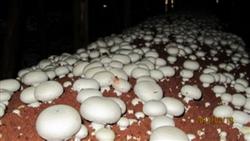
4. Fruiting management: 1. Before fruiting, when large amounts of aerial mycelium appear on the bed surface, quickly reduce humidity and ventilate to make it lie down, which helps the mycelium knot and form primordia. Once the aerial mycelium has lain down, spray the bed surface with 1 kg of clean water per square meter, while strengthening ventilation. When dense mushroom buds appear on the substrate surface, change strong ventilation to gentle ventilation, control shed humidity to above 85%, and take measures such as spraying water on straw mats to lower shed temperature as much as possible and ensure normal growth and development of the mushroom buds.
When the fruiting bodies grow to about 2 cm in diameter, prepare edible fungi three-dimensional nutrient essence (spraying type) with water and spray it directly on the mushrooms. When they grow to 4-8 cm in diameter, harvest promptly according to market demand or order requirements. Unless there are special circumstances, use the "cut all at once" harvesting method to facilitate the occurrence and management of the second flush.
2. After harvesting, immediately clean the bed surface, fill in depressions or cracks, apply a nutrient essence solution once, and then "press down" with clean water, lower temperature, reduce humidity, and keep dark to let the mycelium rest and recover, waiting quietly for the second flush to occur. Management is the same as before. Key points to note: During fruiting, insist on spraying once every 5-7 days with 800-1000-fold Baibingquwuzong or Mushroom Disease-Killing Agent, which can effectively prevent the occurrence of various diseases and contaminating microorganisms.
5. Second production batch: After the second flush is completely harvested, the biological efficiency is generally about 40%, almost the same as the total yield from the conventional harvest of five or seven flushes. By the end of November, the shed can be cleared and treated. After sterilizing the mushroom shed with drugs such as Baibingquwuzong, the second batch of substrate should be started. With proper management, fruiting management begins in February of the following year. In this way, two crops per year can be achieved.
Click to get more button mushroom cultivation techniques
Click to get more edible fungi cultivation techniques