What Is Green Mold Disease in Shiitake Mushrooms? A Complete Guide
What is green mold disease in shiitake mushrooms? An introduction. Green mold is the most common and most damaging competitive contaminant fungus in shiitake mushroom production. If management methods are improper and prevention and control are not timely, it can cause major losses to shiitake mushroom production. 1. Symptoms and conditions of green mold outbreak. In the early stage of green mold outbreak, the mycelium appears as white patches, then...
What is green mold disease in shiitake mushrooms? An introduction
Green mold is the most common and most damaging competitive contaminant fungus in shiitake mushroom production. If management methods are improper and prevention and control are not timely, it can cause major losses to shiitake mushroom production.
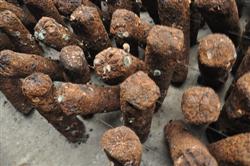
1. Symptoms and conditions of green mold outbreak. In the early stage of green mold outbreak, the mycelium appears as white patches, then gradually turns green, and in the later stage becomes dark green, ink green, until it is soft and rotted. Green mold favors temperatures of 20-32°C and an acidic environment; high temperature and high humidity promote the occurrence and spread of green mold.
2. Causes of outbreak (1) Infection of the spawn. (2) Contamination caused by violation of operating procedures. (3) Infection with green mold caused by incomplete disinfection of inoculation tools, the inoculation room, and the spawn-running room. (4) Green mold contamination caused by damaged bags. (5) High temperature and high humidity make infection with green mold likely.
3. Prevention and control methods. 1. Select spawn that is free of infection, high-yielding, high-quality, and strongly resistant to stress. 2. Place the substrate bags in a stove and heat them until 100°C and hold for 22 hours; they must be thoroughly steamed and cooked through for sterilization and disinfection. When the stove temperature drops to 80%, take them out for inspection, and if there is any damage, promptly seal it tightly with transparent adhesive tape to prevent infection by other contaminant fungi. 3. For a 15-20 sq m inoculation room, fumigate and disinfect with 500 grams of 38% formaldehyde 18 hours before inoculation; place inoculation tools in a sealed inoculation box and disinfect with 15-20 grams of Gubao for 30 minutes; for a 15-20 sq m spawn-running room, fumigate with sulfur the day before, then fumigate and disinfect with 500 grams of formaldehyde. 4. Use temperature to control green mold. The optimal temperature for shiitake mycelium growth is 22-24°C, while green mold is most likely to infect and develop above 23°C. Therefore, based on the different optimal temperatures required by shiitake mycelium and green mold, we carry out control to avoid high-temperature environments.
The measures taken are as follows: (1) Indoor spawn-running period. Spread out the spawn bags and reduce the number of stacked layers. Perforation should be carried out in batches; after perforation, the respiration of shiitake mycelium increases and releases heat, so stop perforation when the room temperature reaches 28%. (2) Summering period. During the summering period, the external ambient temperature reaches above 30°C, so ventilation and cooling must be done well. If summering is done in a fruiting shed, the shed height should preferably reach 2.8 m, and a 60 cm ventilation hole should be left in the back wall every 1.2-1.5 m. The front of the shed film should be fully lifted, and straw curtains should be laid over the shed film to block sunlight; under the racks holding the spawn bags, dig a trench 50 cm wide and 20 cm deep, line it with plastic film, and in case of high temperature put water in the trench and spray water on the ground around the straw-curtain shed to cool it down. Spread lime on the shed floor to reduce humidity. (3) When individual spawn bags are infected with green mold, handle them promptly in the early stage: place the infected spawn bags in a well-ventilated place below 24°C, or place the side of the spawn bag infected with green mold close to cool ground or on a water-filled trench; in this way the shiitake mycelium will grow rapidly and consume the green mold. In the later stage of green mold outbreak, when part of the shiitake spawn bag has turned ink green and is soft, rotted, and deteriorated with no preservation value, cut it off flush with a knife and seal it tightly with yellow mud; after this treatment, the uninfected parts can grow normally, with very good results.
5. Formaldehyde control. The prevention and control of shiitake green mold disease focuses on early detection and timely control. At present, formaldehyde is a highly effective agent for controlling shiitake green mold. When the green mold patch reaches 1 cm in diameter, use a syringe to draw 1.5 milliliters of a mixture of formaldehyde and liquor in a 1:1 ratio and inject 5 shots along the mold patch; when the green mold patch reaches 4 cm in diameter, use a syringe to draw 4 milliliters of a mixture of formaldehyde and liquor in a 1:1 ratio and inject 12 shots along the mold patch; in this way the green mold can be effectively controlled.
Click to get more shiitake mushroom cultivation techniques
Click to get more edible mushroom cultivation techniques