What Is the Almond Mushroom? A Detailed Explanation of Almond Mushroom Cultivation Techniques
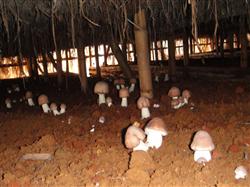
What is the almond mushroom? Please introduce it. The almond mushroom, also known as the Brazilian mushroom, belongs to the subdivision Basidiomycotina, class Hymenomycetes, order Agaricales, family Agaricaceae, genus Agaricus. It is a close relative of the button mushroom (Agaricus bisporus), so its biological characteristics are more similar to that species. "Almond mushroom" is a Japanese commercial name meaning "small pine mushroom." In fact, the almond mushroom bears no resemblance whatsoever to the matsutake (Tricholoma matsutake) in either morphology or flavor; the Japanese call it "small pine mushroom" to cater to Japanese consumer psychology, and in recent years a craze for eating almond mushrooms has emerged in the Japanese market.
What is the almond mushroom? Please introduce it.
The almond mushroom, also known as the Brazilian mushroom, belongs to the subdivision Basidiomycotina, class Hymenomycetes, order Agaricales, family Agaricaceae, genus Agaricus. It is a close relative of the button mushroom (Agaricus bisporus), so its biological characteristics are more similar to that species. "Almond mushroom" is a Japanese commercial name meaning "small pine mushroom." In fact, the almond mushroom bears no resemblance whatsoever to the matsutake (Tricholoma matsutake) in either morphology or flavor; the Japanese call it "small pine mushroom" to cater to Japanese consumer psychology, and in recent years a craze for eating almond mushrooms has emerged in the Japanese market.
The almond mushroom is native to southern North America - California and Florida - as well as northern South America, including Brazil and Peru. It is a delicious wild edible and medicinal mushroom that grows in grasslands along coastal areas. It was introduced to Japan for domestication and trial cultivation in 1965, and commercial cultivation began in 1978. The almond mushroom is crisp, tender and delicious, with an almond aroma, and has certain medicinal effects such as anticancer activity, blood lipid reduction and improvement of arteriosclerosis. It is a mushroom that is both delicious and medicinal.
(1) Morphological characteristics. The fruiting body of the almond mushroom is stout. The cap is flat-rounded to hemispherical, 5-11 cm in diameter, with a surface covered in light brown to chestnut-brown fibrous scales and fragments of the partial veil at the margin. The flesh is thick, white, and turns orange-yellow when injured. The gills are free from the stem, relatively dense, initially milky white, and turn flesh-brown when injured. The stem is cylindrical, solid, slightly enlarged at the base, 4-14 cm long and 2-3 cm thick. The stem above the ring is milky white, while below the ring it is chestnut-brown with cilia-like scales. The ring is attached to the upper part of the stem, membranous, and white. The spore print is dark brown; spores are smooth, broadly elliptical to spherical.
(2) Growing conditions
1. Nutrition. The mycelium of the almond mushroom can use sucrose, glucose and other substances as carbon sources,
but cannot use soluble starch. It can use ammonium sulfate, ammonium nitrate and other substances as nitrogen sources, but cannot use peptone; 7% sucrose and 0.3% ammonium sulfate are the optimal nutrient concentrations. The almond mushroom can decompose and utilize crop straw, animal manure, sawdust and other materials as carbon and nitrogen sources, so these agricultural wastes can be used for cultivation.
2. Temperature. The almond mushroom is a saprophytic fungus that occurs in grasslands in summer and autumn. The mycelium
grows within a temperature range of 10-30°C, with an optimal growth temperature of 23-27°C; fruiting bodies occur within a temperature range of 20-33°C, with an optimal temperature of 22-25°C.
3. Water and humidity. The almond mushroom mycelium can grow when the substrate-to-water ratio of the cultivation material is within the range of 1:1.2-1.4, with the optimal substrate-to-water ratio being 1:1.4; the optimal moisture content of the casing soil is 60%-65%; the relative air humidity for fruiting body development is 80%-95%, with the optimum being 85%-95%.
4. pH. The almond mushroom mycelium can grow within a medium pH range of 4.5-8.0, with an optimal pH of 6.0-7.5.
5. Light. The almond mushroom mycelium does not require light for growth; fruiting body development also must not have direct light, and light affects the quality of the fruiting bodies.
6. Air. Both mycelial growth and fruiting body development of the almond mushroom require fresh air. A large amount of fresh air is needed when fruiting bodies form, and a carbon dioxide concentration exceeding 0.5% affects its mycelial growth and fruiting body development.
Click to get more almond mushroom cultivation techniques
Click to get more edible mushroom cultivation techniques