Agaricus blazei cultivation techniques: How is Agaricus blazei cultivated?
How is Agaricus blazei cultivated? Please explain the method. Agaricus blazei can be cultivated by referring to the following method: Raw material preparation. To cultivate 100 sq m, you need 1500 kg-2000 kg of rice and wheat straw, 1000 kg-1500 kg of livestock and poultry manure (dry), 75 kg-100 kg of rapeseed cake, 35 kg-40 kg of gypsum powder, ...
How is Agaricus blazei cultivated? Please explain the method.
Agaricus blazei can be cultivated by referring to the following method:
Raw material preparation. To cultivate 100 sq m, you need 1500 kg-2000 kg of rice and wheat straw, 1000 kg-1500 kg of livestock and poultry manure (dry), 75 kg-100 kg of rapeseed cake, 35 kg-40 kg of gypsum powder, and 30 kg-35 kg of lime. After the raw materials are ready, pile them for fermentation. The fermented compost has a tea-brown color, feels springy when squeezed in the hand, breaks immediately when pulled hard, and gives off a special fragrance.
Site selection and bed making. Choose a flat place with convenient drainage and close to a water source, and level it into mushroom beds 1 m-1.2 m wide and of unlimited length. Build a simple 2 m high shade shed in the usual way, and hang straw curtains around the beds to prevent intense sunlight.
Filling and spawning
Agaricus blazei can be sown twice a year. In spring, sow from late March to early April and harvest from May to June; in autumn, sow in early to mid-August and harvest from September to November. Before sowing, spray pesticide liquids such as dichlorvos around the compost pile to kill pests, and scatter a little lime powder inside the mushroom bed for disinfection. The compost should be transported to the mushroom bed while hot, impurities removed, and piled 20 cm thick; sow only after the compost temperature drops below 28°C. When sowing, first break the spawn into small pieces, then evenly scatter them on the surface of the compost, pat gently level, and cover with plastic film. Each sq m needs 4 bags-6 bags of spawn. After sowing, build a low arch shed and cover it with plastic film to preserve heat and moisture. From 2 days to 4 days after sowing, when the surface of the compost shows white fluffy mycelium, uncover the film in good time for ventilation to encourage the mycelium to spread into the lower layer of the raw material. If molds such as Mucor or green mold are found, immediately dig out and destroy the contaminated parts to prevent spread. As the mycelium grows larger, uncover the film for ventilation 2 times-3 times a day to keep the air fresh and promote mycelial spread and growth.
Moderate casing soil. Normally from 10 days to 15 days after sowing, when the compost surface is visibly white and dense with mycelium and has extended 1/3 or 2/3 into the lower layer of the raw material, casing soil can be applied to the compost surface. After removing the plastic film from the compost surface, cover first with coarse soil and then with fine soil (both must be strictly disinfected), with a casing thickness of 3 cm-3.5 cm, of which the coarse soil is 2 cm-2.5 cm thick and the fine soil is 1 cm thick. After casing, spray water; the surface soil moisture should be such that it holds shape when squeezed by hand without falling apart and does not stick to the hand.
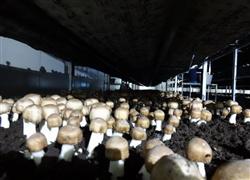
Fruiting management. From 10 days to 15 days after casing, when the soil is parted and large numbers of pure white cord-like mycelium are seen, water can be sprayed in fixed amounts to stimulate fruiting, keeping the soil water content on the compost surface at 22%. When white mushroom buds the size of grains of rice have formed in the soil cracks, ventilate appropriately. When the buds grow to the size of soybean grains, spray water 2 times-3 times a day, following the principle of spraying more on sunny days, less on cloudy days, and stopping on rainy days; never pour large amounts of water on young mushrooms, so as to avoid wilting and death. During this period, keep the temperature in the bed at 22°C-24°C and the relative air humidity at 85%-90%, and try to avoid too great a difference between day and night temperatures. During high temperatures, pouring large amounts of water around noon is strictly forbidden. When the fruiting bodies grow to 2 cm-3 cm in size, stop spraying water and ventilate regularly to help the mushrooms grow robustly.
Timely harvesting. Agaricus blazei takes 35 days-45 days from sowing to harvest, and after budding it continues to fruit for 2 months-3 months.
Agaricus blazei fruiting bodies grow rapidly and easily open their caps and change color, so they must be harvested in good time. At peak times, harvest 2 times-3 times a day.
Harvest standard: the cap of the mushroom is hemispherical or flat-round, and the veil is unbroken. When harvesting, pinch the middle of the stipe tightly with the hand and pull it up gently
(do not injure the surrounding young mushrooms), then immediately scrape off impurities such as rotten grass and mud at the base of the stipe with a small knife, and put the mushrooms into plastic bags for fresh sale.
Click to get more Agaricus blazei cultivation techniques
Click to get more edible mushroom cultivation techniques