What is enoki mushroom branching disease? A detailed guide to its cultivation techniques
What is enoki mushroom branching disease? An introduction and control methods. Enoki mushrooms that only grow stipes without growing caps, commonly known as enoki mushroom branching disease, or needle-tip mushrooms, is a non-infectious physiological disorder. When cultivation bags or mushroom bottles shift from the mycelium growth stage to the fruiting body formation stage, mushroom buds appear in clusters, growing only stipes without forming...
What is enoki mushroom branching disease? An introduction and control methods
Enoki mushrooms that only grow stipes without growing caps, commonly known as enoki mushroom branching disease, or needle-tip mushrooms, is a non-infectious physiological disorder. When cultivation bags or mushroom bottles shift from the mycelium growth stage to the fruiting body formation stage, mushroom buds appear in clusters, growing only stipes without forming caps. When the stipes elongate to a certain length, branches form at the tips, and after the small branches grow for a certain time they branch again. The longer the small branches grow, the thinner and weaker they become and they droop, forming a cluster of mycelium resembling disheveled hair, completely unlike normally growing fruiting bodies whose stipes grow upward and whose tips swell to form caps. Their caps remain stagnated in the juvenile form at the time of primordium development, with a diameter of about 1~2 mm. The entire cluster of mushrooms appears beard-like, with individual mushrooms short and slender, without caps, slightly thicker in the middle-lower part, resembling a needle tip. Fruiting body growth is severely inhibited, with almost no yield.
The causes of the disease
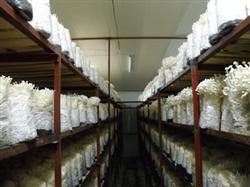
This is due to poor ventilation in the mushroom yard, excessively high carbon dioxide concentration, and excessively high humidity, which inhibit cap growth. This disease is mostly seen in air-raid shelters, tunnels and other cultivation sites where the ambient air is not circulating. For bag-cultivated or bottle-cultivated enoki mushrooms, when the mycelium grows to a certain stage and shifts to fruiting body formation, that is, after primordia appear, appropriate ventilation should be maintained and a certain amount of light stimulation should be provided, and the humidity of the mushroom house should be reduced. At this stage, if the carbon dioxide concentration accumulated inside and outside the bottle mouth or bag mouth is too high, oxygen is insufficient and weak light stimulation is lacking, and in addition the humidity is too high, the fruiting bodies grow abnormally, growing only stipes without forming caps, and continuously producing branches at the tips.
Control methods
The fruiting site must have good ventilation conditions. For bottle-cultivated enoki mushrooms, after the fruiting body primordia form, first carry out 3~5 days of young mushroom shaping culture, and then bag them to grow mushrooms. After bagging, the bags should be lifted and moved up and down 1~2 times a day to exchange air. For bag-cultivated enoki mushrooms, in the early stage of fruiting body growth, ventilation must be immediately strengthened to reduce the carbon dioxide concentration. The covering can be lifted open to keep sufficient fresh air inside the mushroom bags, so as to promote cap differentiation and stipe thickening. After the caps develop normally, manage them according to the cultivation management methods for commercial mushrooms. Once it is found that mushroom buds are growing abnormally and the stipe tips are forking and drooping, remove them promptly and recreate environmental conditions favorable for fruiting body formation, and they can still grow normally.
Click to get more enoki mushroom cultivation techniques
Click to get more edible mushroom cultivation techniques