How do you clear weeds when growing chives in a greenhouse?
How do you remove weeds when growing chives in a greenhouse? Please explain the methods. Greenhouse chives are generally grown by transplanting; after transplanting, you can use pendimethalin, prometryn, or butralin for soil-closure treatment. Apply 150 ml of 330 g/L emulsifiable concentrate per mu or 200-250 ml of 48% butralin emulsifiable concentrate, add 50 kg of water...
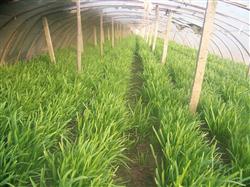
How do you remove weeds when growing chives in a greenhouse? Please explain the methods.
Greenhouse chives are generally grown by transplanting; after transplanting, you can use pendimethalin, prometryn, or butralin for soil-closure treatment. Applying 150 ml of 330 g/L emulsifiable concentrate per mu or 200-250 ml of 48% butralin emulsifiable concentrate, add 50 kg of water and spray, can control many kinds of grass weeds and some broadleaf weeds, and is relatively safe for chives. Applying 100-150 g of 50% prometryn wettable powder per mu by spray can control many kinds of broadleaf weeds. On sandy soil and sandy loam, it is best not to use prometryn, to prevent the chemical from leaching to the chive roots after repeated irrigation and causing phytotoxicity.
Old-root chives have strong pesticide tolerance; besides the above chemicals, you can also use trifluralin, oxyfluorfen, and other chemicals to control weeds. In fields with many grass weeds such as shortawn foxtail, you can spray 100-150 ml of 48% trifluralin emulsifiable concentrate per mu. To avoid affecting chive growth, spray directionally as much as possible and avoid the spray liquid contacting the chives. Trifluralin volatilizes easily and loses effectiveness through photodegradation, so after spraying, cultivate and mix it into the soil 1-3 cm deep. For fields where grass weeds are mixed with broadleaf weeds and sedges, you can spray 50-60 ml of Goal 24% oxyfluorfen emulsifiable concentrate per mu. When oxyfluorfen is used for chemical weeding, brown spots appear on the leaf tips after the chives emerge, and after a few days the spots disappear on their own. These chemicals are all soil-closure treatment agents and have poor control efficacy against older weeds, so large weeds should first be pulled by hand. In old-root chive fields, generally after each cutting, a herbicide should be sprayed once, and application should be timed after the wound has healed. If applied before the wound has healed, the chemical enters through the wound, and phytotoxicity very easily occurs. For example, if prometryn is used before the wound has healed, it inhibits chive photosynthesis, reduces the number of harvests, and also narrows the leaves, lowering quality.
After spraying trifluralin and other herbicides, attention should be paid to ventilation in the greenhouse; otherwise, the concentration of volatilized herbicide is too high, or the chemical dissolves into the water on the greenhouse film and drips onto the new chive leaves with the water droplets, easily causing phytotoxicity to the chives.
When grass weeds occur in the field during the chive growing period, you can use quizalofop-p-ethyl, haloxyfop-R-methyl, and other chemicals for control; when grass weeds and broadleaf weeds occur together, if the weeds are young, spraying oxyfluorfen gives good weed control, but it easily produces burn spots on chive leaves and affects appearance.
When weed damage is severe, especially when perennial malignant broadleaf weeds and sedges occur rather seriously, if the chives have already grown to a certain amount, you can consider first selectively cutting the chives (not cutting the weeds), properly covering the cut stubble with clean cloth, and then spraying Starane 200 g/L fluroxypyr emulsifiable concentrate or bentazone to control the malignant broadleaf weeds and sedges in the field. Among them, fluroxypyr has good control efficacy against broadleaf weeds, and bentazone has good control efficacy against sedges. Both chemicals may cause some phytotoxicity to chives, so it is best not to spray them directly on chives over the long term during the growing period. Before applying over a large area, first test on a small area, and after success, expand the area.
Click to get more chive growing techniques
Click to get more herbicide application techniques
Click to get more pesticide application techniques