What are the control methods for ginger bacterial wilt and ginger stem borer?
How do you control ginger bacterial wilt and ginger stem borer? Please explain the control methods. For ginger bacterial wilt and ginger stem borer, the following methods can be used for control: 1. Bacterial wilt. This disease, also known as ginger rot, is the most common devastating disease in ginger production and is also the main factor restricting ginger production and quality. In recent years...
How do you control ginger bacterial wilt and ginger stem borer? Please explain the control methods.
For ginger bacterial wilt and ginger stem borer, the following methods can be used for control:
1. Bacterial wilt. This disease, also known as ginger rot, is the most common devastating disease in ginger production and is also the main factor restricting ginger production and quality. In recent years it has recurred severely year after year in our county. According to the author's survey statistics, the average diseased plant rate of this disease is 19.3%, reaching as high as 49.6% in severely affected plots, with some fields even suffering total crop failure. The annual yield loss caused by this disease is as high as more than 40,000 tons.
1. Symptom identification: This disease mainly damages ginger stems, leaves and rhizomes. The aboveground stem parts, when affected, turn dark purple, and the internal tissue turns brown and rots, leaving only fibers. The vast majority of leaves first lose water and curl toward the underside of the leaf, the leaves droop, and the vascular bundles turn brown, after which the plant dies of bacterial wilt; however, the plant remains upright and does not lodge. A small number of severely affected plants have leaves that turn withered yellow from bottom to top. The rhizome at the early stage of the disease appears water-soaked and yellow-brown, after which the internal tissue gradually softens and rots, leaving only the outer skin. Squeezing the diseased part reveals milky white bacterial ooze exuding from the vascular bundles. When the diseased plant is pulled up, it rots at the rhizome and gives off a foul odor. When the roots are affected, they also appear light yellow-brown and eventually rot completely.
2. Disease occurrence pattern: The pathogen overwinters in rhizomes and soil, and generally can survive in soil for more than 2 years. Contaminated seed ginger is the main primary infection source, and this diseased soil is also an important infection source of bacterial wilt. In our county, ginger generally begins to develop the disease at the end of May and the beginning of June. During field surveys in mid-June, scattered disease centers can be seen. From the end of June to early and mid-July is the period of frequent occurrence of this disease, because the high temperature and abundant rain during this period provide favorable conditions for the expansion, invasion and reproduction of the pathogen. Therefore, in years with high temperature and abundant rain, this disease often becomes epidemic in a short period, causing severe damage. From late July to early and mid-September is the peak period of this disease. At this time, patches of yellow-brown diseased plants can be seen in the field, and severely affected plots may have all plants die.
3. Control methods: Bacterial wilt has many transmission routes and a long disease period, making control relatively difficult. At present there is no ideal chemical agent, so agricultural control measures should be the main approach, combined with physical control and supplemented by chemical control, in order to cut off transmission routes and control the occurrence and spread of the disease as much as possible.
(1) Agricultural control. Strictly select disease-free seed ginger and implement crop rotation of more than 4 years. Combined with careful management, applying clean manure and irrigating with clean water can cut off the route of soil-borne transmission of the bacteria and reduce the occurrence of this disease to a minimum.
(2) Physical control. For fields that have already developed the disease, achieve early detection and early handling. Local farmers generally seal off the disease center and the surrounding soil and diseased plants with plastic (11480, 40.00, 0.35%) film, and spread quicklime within a 1-meter range around it for disinfection, which can greatly reduce the spread and expansion of the disease.
(3) Chemical control. Some bactericidal agents can be selected, such as 72% agricultural streptomycin powder at 2000 times dilution, or 80% Shajun Xianfeng wettable powder at 800 times dilution, or 70% Keshade wettable powder at 1500 times dilution for root drenching control. For each ginger clump, pour 250 grams of the solution at the roots each time, applying the agent once every 7-10 days, for 3-4 consecutive applications.
2. Ginger stem borer. Ginger stem borer, also known as the heart-boring worm, is an omnivorous pest that can cause damage from ginger emergence until before harvest. In ordinary years, the damaged plant rate of this pest in ginger fields is 2-5%, and if control is neglected it can reach a damage rate of more than 10%.
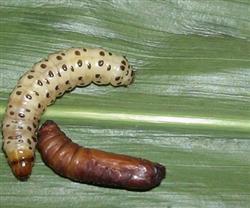
1. Occurrence pattern: The ginger stem borer mainly damages by feeding as larvae. Two to three days after hatching, the larvae can invade from the gaps between the leaf sheath and stem or from the heart leaf at a height of 1-5 cm above the ground, and there are obvious boring holes at the invasion sites. After boring in, the larvae bore upward while feeding, causing the stem to become hollow, which blocks the transport of water and nutrients. The damaged leaves become membranous and retain frass, with irregular feeding holes on the leaves, and the stem and leaf sheath are often bitten into ring-like marks. After the seedling stage is damaged, the upper leaves wither and yellow or the stem breaks, while the lower leaves generally still appear normal, so during field surveys plants with withered tops and green lower parts can be clearly seen as ginger stem borer damage. At this time, locate the insect entrance and peel off the stem, and the feeding larvae can generally be seen. The larvae are about 1-3 cm long; before the 3rd instar they are milky white, and when mature they are light yellow or brown.
2. Control methods
(1) Manual capture. Because this pest bores in to cause damage, the control effect of ordinary chemical agents is generally not very good, especially since older larvae have strong resistance. Manual capture is advocated. Generally, in the morning, if plants in the field are found to have just been bored and damaged, locate the insect entrance, peel open the stem, and the larvae can be found.
(2) Chemical control. The larvae have the strongest pesticide resistance before the 2nd instar, so early and small-stage control should be advocated, with timely spraying for control. Suitable agents include 15% DuPont Anda suspension concentrate at 4000-5000 times dilution, or 5% Regent suspension concentrate at 3000-4000 times dilution, or 20% Yiwangdajin emulsifiable concentrate at 2000-2500 times dilution, sprayed on field plants; the above agents can also be injected into the insect entrance for control.
Click to get more ginger cultivation techniques
Click to get more insecticide application techniques
Click to get more pesticide application techniques