What should be noted when controlling the rice leaf roller (Cnaphalocrocis medinalis) in rice?
What should be noted when controlling the rice leaf roller in rice? Please give guidance. To control the rice leaf roller, you must first know the timing of control. The control timing is determined comprehensively through the development progress of the insect stages and the fluctuation dynamics of adults under light traps, with reference to the stage duration table and in combination with short- and medium-term weather forecasts. To ensure a true grasp...
What should be noted when controlling the rice leaf roller in rice? Please give guidance.
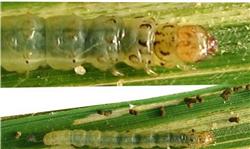
To control the rice leaf roller, you must first know the timing of control. The control timing is determined comprehensively through the development progress of the insect stages and the fluctuation dynamics of adults under light traps, with reference to the stage duration table and in combination with short- and medium-term weather forecasts. To truly grasp the optimal control period, we must understand the damage characteristics of the larvae. First-instar larvae are in the "white spot stage," crawling into the leaf sheath or the inner side of tender leaf sheaths to feed during the tillering stage, and during the booting and heading stages, they crawl to old larval rolls or the inner side of tender leaf sheaths of ineffective tillers to feed; second-instar larvae are in the "tip-binding stage," rolling leaf tips into small larval rolls, hiding and feeding inside; third-instar larvae are in the "waist-binding stage," rolling the middle of leaves into longer larval rolls, forming obvious white leaves; fourth-instar larvae enter the "roll-transferring stage," frequently moving between rolls and causing damage, with white leaves gradually increasing; fifth-instar larvae enter the "binge-feeding stage," with damaged leaves turning scorched white, and the entire rice field covered with white leaves. Fourth- and fifth-instar larvae consume more than 90% of the total food intake and cause the greatest damage. The rice leaf roller should be controlled by spraying from the peak hatching period of eggs to the early peak stage of young larvae to achieve the best effect. However, we often find that many farmers spray at will without grasping the control timing. Because the occurrence time of the rice leaf roller varies from year to year, the control timing differs each year. Therefore, if spraying is not done in time during the optimal control period, and instead the field is treated only when white leaves are seen, the rice leaf roller larvae have already reached advanced instars, the control effect declines, and ultimately it is undoubtedly "a waste of effort and resources, with more loss than gain."
To control the rice leaf roller, secondly, you must understand the target of control. Only by understanding the target of control can you achieve precision. The severity of rice leaf roller occurrence is closely related to climatic conditions. Under suitable temperatures and high humidity, adult oviposition, hatching, and larval survival are favored. Therefore, suitable temperatures, many rainy days, and high-humidity weather with heavy dew favor the occurrence of the rice leaf roller. Adults have phototaxis and a preference for tender green plants, prefer shade and moisture, and can migrate over long distances. Only after understanding the living habits and damage characteristics of the rice leaf roller can one truly "prescribe the right remedy" and establish key targets for control.
To control the rice leaf roller, thirdly, you must master the control agents. Judging from the remarkable results achieved in rice pest control in this city in recent years, ideal agents for controlling the rice leaf roller include efficient, low-toxicity, low-residue, environmentally friendly pesticides such as Kangkun, Daoteng, and Longge. Kangkun, namely 20% chlorantraniliprole suspension concentrate, is a stomach-poison and contact pesticide. The dosage per mu is 10 mL (2 small packets), diluted with water and sprayed evenly on stems and leaves. The water volume per mu is 30 kg (increase the water volume as appropriate according to rice growth conditions and pest conditions). If the occurrence is severe (with serious generation overlap), spray once more at an interval of 15 days; Daoteng is a 10% suspension concentrate, a suspension concentrate mixed in a ratio of 6.7% flubendiamide (developed by Nihon Nohyaku Co., Ltd.) and 3.3% abamectin. Its main modes of action are stomach poison and contact action. Its pre-harvest interval when used on rice is 28 days, and it can be applied at most 2 times per growing season; Longge is a 20% flubendiamide water-dispersible granule, mainly acting as a stomach poison, with some contact action, and a long residual effect period. For controlling rice borers, apply at the peak hatching period of eggs to the young larval stage, 2 to 3 times per season, with an application interval of about 30 days.
Prevention first, integrated control. Only by achieving "knowing the timing, knowing the pest situation, knowing the dosage, and prescribing the right remedy" in controlling the rice leaf roller can rice grow healthily and promote grain production and increase farmers' income.
Click to learn more insecticide application techniques
Click to learn more pesticide application techniques
Click to learn more rice cultivation techniques