How to Grow Bamboo Fungus for High Yields? Detailed Growing Techniques
How can bamboo fungus be grown for high yields? Please give some guidance. To achieve high yields in bamboo fungus cultivation, you need to understand the growing techniques. The following introduces one bamboo fungus cultivation technique for reference: 1. Field requirements. The field for bamboo fungus cultivation should have convenient transportation, loose and fertile soil, high humus content, good aeration, and be resistant to...
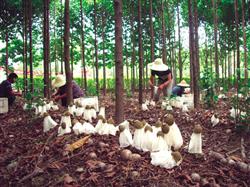 How can bamboo fungus be grown for high yields? Please give some guidance
To achieve high yields in bamboo fungus cultivation, you need to understand the growing techniques. The following introduces one bamboo fungus cultivation technique for reference:
1. Field requirements
The field for bamboo fungus cultivation should have convenient transportation, loose and fertile soil, high humus content, good aeration, and be resistant to compaction. For the field to be planted, one month before planting, on rainy days, apply 30 kg of urea and 50 kg of superphosphate per mu to increase the nutrients of the casing soil.
The following 4 types of fields are not suitable for growing bamboo fungus: (1) The selected field should be protected against both drought and waterlogging. (2) Bamboo fungus cannot be grown continuously on the same land; there must be an interval of more than three years, and it is best if the surrounding fields have never grown bamboo fungus. In areas with many years of cultivation, yields decline year by year. (3) Fields where crops such as sweet potato and corn were grown that year are not suitable. (4) Fields mainly of fine sand have poor water retention, are prone to drought, and give low yields.
2. Variety selection
Currently, the varieties grown for bamboo fungus are: Dictyophora indusiata D89, D1 and D42, with D89 and D1 being the main ones, using 600 bags of spawn per mu (each bag 0.5 kg). The more spawn used per mu, the faster the mycelium grows, the earlier and more uniform the fruiting, and the higher the yield.
The quality of the spawn determines the yield for the whole year. Whether at the early stage of culture or at physiological maturity, the spawn should have white mycelium that is thick and strong, in strands, with dense aerial mycelium, feel rather hard to the touch, and have moderate moisture content in block form. When buying spawn, check whether the spawn factory has complete certificates and ask for an invoice.
3. Preparing materials and building piles
The material preparation time is generally chosen from September to December. The substrate chosen should be fresh; blackened, rotted raw materials have already deteriorated and are not suitable for use. During the stacking period after the raw materials are purchased, prevent high temperatures combined with rain from causing natural fermentation that burns the materials and reduces the nutrients of the substrate.
The contents of the "three increases". First, increase the amount of spawn used; relatively more spawn means earlier fruiting and higher yields. Second, increase the proportion of nitrogen fertilizer; urea should account for 1% of the substrate. Third, increase the amount of substrate used, with 6000 kg per mu (13 m).
(1) The main types of substrate include bamboo shavings, wood shavings, soybean stalks, rice husks, giant king grass, etc.
(2) Amount of materials prepared per mu: bamboo shavings 11 m, wood shavings 2 m, urea 50 kg, light calcium carbonate 25 kg, wheat bran 50
kg. The pH of the casing soil and substrate is required to be 5~6.
(3) Building piles for fermentation: Bamboo fungus is a saprophytic fungus. Through building piles for fermentation, complex carbohydrates are degraded into nutrients that bamboo fungus mycelium can easily absorb and utilize.
Pile building for fermentation begins in early December each year. During operation, spread urea and light calcium carbonate on each layer of raw material, then pour on clean water so that the substrate has a moisture content of about 60%, then add another layer of raw material, sprinkle urea and light calcium carbonate, and repeat this process so that the pile is about 1.5 m high. Turn the pile once every half month, and add water according to whether the substrate is dry or wet. The principle of turning the pile is to exchange the inner and outer materials, turning the pile in place, and making use of sunny days with higher temperatures, when heat loss during turning is small, which helps the substrate heat up and ferment again. Turn 3~4 times in total. The pile-building fermentation process takes 50-60 days, until the waste gases in the substrate are completely released.
The purpose of building piles for fermentation is, on the one hand, to increase the nitrogen content of the substrate, making it soft and humified, which is conducive to decomposition by the mycelium and promotes mycelial growth, thereby increasing yields. On the other hand, the high temperature produced during fermentation kills contaminating bacteria and pests and destroys the alkaloids in the substrate.
4. Sowing period
Bamboo fungus is a mesophilic fungus. The mycelium growth temperature range is 8~30°C, with the optimum at 20~26°C; the fruiting body range is 19~28°C, with the optimum at 22~26°C. Sowing can be done when the temperature stabilizes above 8°C, and mid-January to February is the most suitable time each year. 70~80 days after sowing, it enters the stage of primordium and fruiting body development. When the temperature is above 20°C, fruiting occurs. Harvesting can begin in late April and ends in mid-September. With high yields, 3~5 flushes of bamboo fungus can be harvested.
Click to get more bamboo fungus cultivation techniques
Click to get more edible mushroom cultivation techniques