How should bamboo fungus (Phallus indusiatus) be cultivated to achieve high yields?
How can bamboo fungus cultivation achieve high yields? Please introduce the methods. To achieve high yields in bamboo fungus cultivation, the following points should be noted: 1. Cultivation site: Choose sandy loam woodland with convenient drainage and irrigation, and make beds under the forest canopy with a shading density of 80%-90%. The beds should be 15-20 cm deep, 40-50 cm wide, oriented north-south, with length depending on...
 How can bamboo fungus cultivation achieve high yields? Please introduce the methods.
To achieve high yields in bamboo fungus cultivation, the following points should be noted:
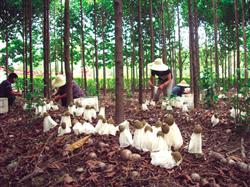
1. Cultivation site: Choose sandy loam woodland with convenient drainage and irrigation, and make beds under the forest canopy with a shading density of 80%-90%. The beds should be 15-20 cm deep, 40-50 cm wide, oriented north-south, with length depending on the amount of material used and the site conditions.
2. Laying material and sowing: Select dry, mold-free fresh wheat straw, soak it thoroughly in water (moisture content about 65%), take it out and put it into the beds for laying material and sowing. One layer of wheat straw and one layer of spawn, for a total of two layers of material and two layers of spawn. The upper layer of spawn should account for 2/3 of the total sowing amount, with a sowing rate of 1 bottle of 750 ml spawn per 5 kg of wheat straw. After sowing the second layer, sprinkle a small amount of water-soaked wheat straw on top. The growing material should be compacted and stand 2 cm above the ground.
3. Seasonal arrangement: In North China, bamboo fungus can be sown from April to July. If sown in April, harvest in June-July; if sown in May, harvest in July-August; if sown in June, harvest in August-September; if sown in July, harvest in September-October.
4. Spawn running management:
(1) Casing soil Immediately after sowing, cover with a 3-4 cm thick layer of soil. The soil particles should not be too coarse or too fine, and the soil should be clean and fertile. About 20 days after sowing, when the bamboo fungus mycelium emerges through the soil surface, cover with soil once more, 1-2 cm thick.
(2) Shading After sowing, when the mycelium shows through the surface casing soil, build a small arched shed over the bed, 30-50 cm high, with width depending on the bed width. Cover the shed with straw mats or old burlap sacks, etc., to both block wind and provide shade.
(3) Water retention Keep the moisture content of the wheat straw and the casing soil layer stable. Too dry or too wet will both affect mycelial growth. In rainless weather, pay attention to spraying water once every 3-5 days to maintain the humidity of the casing soil and growing material. During rainfall, pay attention to drainage. To prevent flooding, dig a drainage ditch beside the bed. In rainy weather, cover the small arched shed with plastic film. The mycelium of Dictyophora indusiata (long-skirted bamboo fungus) grows well in wheat straw, and under natural temperatures it can emerge through the casing soil layer after 40-50 days. From sowing to the enlargement of the ends of the rhizomorphs to form granular fungus balls requires 60-65 days.
(4) Fungus ball stage Under natural temperature conditions from June to September, the mycelium grows normally, and fungus balls form at the tips of the rhizomorphs on the soil surface. They are initially rice-grain shaped, and after 3-5 days grow to the size of soybeans, milky white with a smooth surface. After another 2-4 days, they reach the size of peanut kernels, and rhizomorph-like bristles begin to appear on the surface of the fungus balls, appearing grayish white. After another 4-6 days, they can grow to the size of walnuts or eggs. At about 16 days, the bristles elongate and then recede, and the fungus balls become light gray or grayish brown. When light is strong, the fungus balls are darker in color; when light is weak, they are lighter. When the fungus balls no longer increase in size, it indicates they have matured.
(5) Maturation stage From formation to mature splitting, the fungus balls require 21-23 days. During this period, humidity management must be emphasized. On one hand, water should be sprayed appropriately to raise the moisture content of the substrate from 65% to 75%; on the other hand, ensure that the relative air humidity of the micro-environment where the fungus balls grow reaches above 80%. At the same time, weak light stimulation should also be provided, uncovering the shed covering for 1 hour each day. If windy weather occurs, cover the shed film tightly to prevent the fungus balls from drying out in the wind.
Mature fungus balls can split at 22-26°C and a relative air humidity of 85%-95%. Initially the top of the fungus ball ruptures, and the cap and stipe squeeze out successively. After the stipe extends, the indusium (skirt) is discharged from between the stipe and the cap.
5. Harvesting and processing: When the indusium (skirt) reaches its maximum opening, harvest immediately. When harvesting, pick the entire fruiting body from below the volva, remove the cap and volva, and keep the indusium and stipe intact. Place them on clean white cloth to dry in the sun. When arranging them, make sure the indusium is spread out and the stipe is placed straight, so as to obtain neat and attractive commercial products.
Click to get more bamboo fungus cultivation techniques
Click to get more edible mushroom cultivation techniques