What Is Wine Cap Mushroom? Get to Know This Edible Fungus
What is the wine cap mushroom? Here is an introduction. Zhongdi Network has compiled information on the wine cap mushroom, listed below for readers' reference. The wine cap mushroom, also known as the wrinkled giant stropharia, wrinkled stropharia, or burgundy mushroom, is one of the top ten mushrooms on the international mushroom trade market, and is also one of the fungi recommended by the United Nations [Weibo] Food and Agriculture Organization (FAO)...
 What is the wine cap mushroom? Here is an introduction.
Zhongdi Network has compiled information on the wine cap mushroom, listed below for readers' reference.
The wine cap mushroom, also known as the wrinkled giant stropharia, wrinkled stropharia, or burgundy mushroom, is one of the top ten mushrooms on the international mushroom trade market, and is also one of the fungi recommended by the United Nations [Weibo] Food and Agriculture Organization (FAO) for cultivation in developing countries.
Several years of introduction and promotion have shown that the wine cap mushroom has very broad development prospects. First, its cultivation technique is simple and extensive, and it can be cultivated directly using raw materials; it has strong resistance to competing organisms and is easy to grow successfully. Second, the sources of cultivation materials are abundant, as it can grow on various straw substrates (such as rice straw, wheat straw, flax stalks, etc.).
In the vast rural areas of our country, it can serve as a major measure for handling straw. The spent material after cultivation can be returned directly to the field, improving the soil and increasing fertility. Third, the wine cap mushroom has strong stress resistance and a wide temperature range for adaptation; it can fruit within the range of 4-30°C, and in provinces and regions such as Fujian and Guangdong it can overwinter naturally. Because the suitable growing season is long, it is helpful for adjusting to market supply during the off-season for other fungi or vegetables. Fourth, because the wine cap mushroom has high yield, low production cost, and rich nutrition, it is easily accepted by a broad range of consumers as soon as it is introduced to the market as a new product.
1. Morphological characteristics
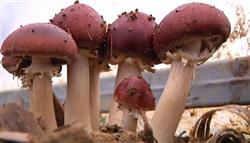
The fruiting bodies are solitary, clustered, or in groups, medium to large, with a single mushroom cluster reaching several kilograms in weight. The cap is nearly hemispherical, later flattening, with a diameter of 5-45 cm. The cap is fleshy, and the surface is slightly sticky when moist. Young fruiting bodies are initially white, often with small nipple-like protrusions; as the fruiting body gradually grows, the cap gradually turns reddish brown to wine reddish brown or dark brown, and after maturing fades to brown to grayish brown. Some caps have fibrous scales, which gradually disappear as the fruiting body grows and matures.
The edge of the wine cap mushroom's cap is inrolled and often bears remnants of the partial veil. The flesh is thick and white. The gills are adnate, densely arranged, initially dirty white, later turning grayish white, and as the cap flattens, gradually becoming brown or purplish black. The stipe is nearly cylindrical, slightly enlarged near the base, 5-20 cm long and 0.5-4 cm thick; above the ring it is dirty white and nearly smooth, and below the ring it has yellowish fine striations.
The stipe is initially solid with pith, and gradually becomes hollow after maturity. The ring is membranous, relatively thick or double-layered, located on the upper middle part of the stipe, white or nearly white, with rough striations on the upper surface, deeply split into several fragments, with the tips of the fragments curling slightly upward, easily shedding, and often disappearing on mature fruiting bodies. The spore print is purplish brown; spores are smooth, brown, elliptical, with pitting. The apex has a distinct germ pore, thick-walled; cheilocystidia are club-shaped, with a small protrusion at the apex.
2. Ecological habits
The wine cap mushroom grows from spring to autumn in forests, on grassland at forest edges, or by roadsides, in gardens, at refuse dumps, on sawdust piles, or on cattle and horse manure piles in pastures. Under artificial cultivation in Fujian Province, except that no fruiting is seen from July to September, mushrooms can grow in other months, but fruiting is abundant and growth is fast mainly from late October to early December and from early March to April. Wild wine cap mushrooms on the Qinghai-Tibet Plateau grow on the leaf litter layer under broad-leaved forests, and in the Panxi region they grow in mixed coniferous and broad-leaved forests.
3. Distribution
In nature, the wine cap mushroom is distributed in Europe, North America, Asia, and other places. In European countries such as Poland, Germany, the Netherlands, and the Czech Republic, it is cultivated. In our country, wild wine cap mushrooms are distributed in Yunnan, Sichuan, Tibet, Jilin, and other places.
Click to get more wine cap mushroom cultivation techniques
Click to get more edible fungus cultivation techniques