What diseases need to be prevented and controlled when cultivating shaggy ink cap mushrooms?
What diseases need to be prevented and controlled when cultivating shaggy ink cap mushrooms? We ask knowledgeable readers to help explain. The shaggy ink cap mushroom is a straw-decaying, soil-inhabiting fungus with extremely strong adaptability, but during cultivation it is necessary to prevent and control the harm of Ustilaginoidea virens, soft rot, and brown blotch disease. Zhongdiwang has compiled their harm and control methods for the above diseases, listed in detail below...
 What diseases need to be prevented and controlled when cultivating shaggy ink cap mushrooms? We ask knowledgeable readers to help explain.
The shaggy ink cap mushroom is a straw-decaying, soil-inhabiting fungus with extremely strong adaptability, but during cultivation it is necessary to prevent and control the harm of Ustilaginoidea virens, soft rot, and brown blotch disease. Zhongdiwang has compiled their harm and control methods for the above diseases, listed in detail below for readers' reference.
The harm of Ustilaginoidea virens:
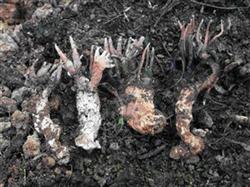
Ustilaginoidea virens, namely Xylaria furcata, is a parasitic pathogenic fungus that has caused serious harm in recent years. It mainly occurs during the fruiting body growth stage of the shaggy ink cap mushroom. Its fruiting body closely resembles a chicken claw, hence the common name "chicken claw fungus."
When the shaggy ink cap mushroom mycelium grows, it is disturbed by mold mycelium in the soil. The two combine and twist, undergoing metamorphosis to grow into chicken claw mushrooms. When they appear, they are dark brown, slender and pointed, connected at the base. Their mycelium competes with the shaggy ink cap mushroom for nutrients and inhibits its mycelial growth, causing severe yield reduction or even total crop failure. Ustilaginoidea virens mostly occurs in large numbers in late autumn and early summer and after the second flush of mushrooms. Dark, high-temperature, high-humidity, poorly ventilated conditions with excessive moisture in the mushroom bed easily trigger this disease.
Control of Ustilaginoidea virens:1. Use high-quality pure spawn;
2. All raw materials must be fresh, dry, and free of mold;
3. Add 0.1%-0.2% of 50% carbendazim or Kemeiwang, etc. to the culture material to inhibit the growth of contaminating bacteria;
4. Pile fermentation must be thorough; sterilized substrate cultivation is best;
5. Be careful when selecting casing soil; sterilize it when necessary;
6. When cultivating in seasons with relatively high temperatures, it is best not to remove the bags before casing and fruiting, to avoid cross-contamination;
7. In management, pay attention to cooling, reducing humidity, increasing ventilation, and avoiding water accumulation in the mushroom shed;
8. The incidence rate is high when cultivating in late spring and early summer or in high-temperature summer and autumn seasons. Generally, planting in September to October is preferable.
9. Once Ustilaginoidea virens is found, dig it out promptly to prevent spores from maturing and spreading, and treat the infected area with pollution-free chemicals.
The harm of soft rot:
Soft rot is a common disease caused by bacteria and is relatively serious. Infected fruiting bodies first turn brown, then the caps become black and rot, eventually leaving only the stipes. High temperature and high humidity with poor ventilation easily trigger this disease, and the incidence rate is high during off-season cultivation in summer.
Control of soft rot:1. Before feeding, disinfect the mushroom shed with lime water, caustic soda, etc.
2. Air humidity and casing soil moisture content should be slightly lower.
3. In the early stage of the disease, agricultural streptomycin (concentration 100-200 mg/1000 ml) can be used for control; promptly remove diseased mushrooms to prevent contagion.
The harm of brown blotch disease:
In the early stage of brown blotch disease infection, brown patches appear on the stipe and cap of the fruiting body, gradually expanding until the entire mushroom body turns brown. Excessive humidity in the casing layer and environment and improper watering during fruiting easily trigger this disease, and it is prone to occur during off-season cultivation in summer.
Control of brown blotch disease:1. During the fruiting period, the moisture content of the casing soil should not be too high; it is best when the soil does not stick to the hands and the surface layer shows white.
2. During the fruiting period, avoid spraying water onto young mushrooms as much as possible; when environmental humidity is high, increase ventilation to reduce humidity.
What should be noted when cultivating shaggy ink cap mushrooms
Method of cultivating shaggy ink cap mushrooms with distiller's grains