How to grow loofah? Detailed explanation of planting techniques
Seed selection and sowing Loofah prefers higher temperatures; seedlings grow slowly at low temperatures. It can be grown by raising seedlings for transplanting or by direct sowing. Before sowing, the seeds are generally pre-germinated first by soaking them in water for8~10hours, then taken out and wrapped in a wet cloth, placed in a warm place, and after2~3days, once they sprout, they are sown. In the Yangtze River basin region, cold frames are mostly used for raising seedlings from late3to early4. For open-field direct sowing, seedlings are raised from late4to early5. In South China, large-scale cultivation is mainly of angled loofah, which can be divided into three sowing periods: spring sowing in2~3, summer sowing in4~5, and autumn sowing by direct sowing in early7~8.
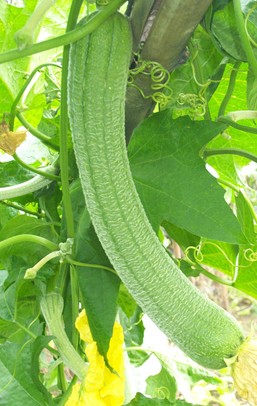
Cultivation points Loofah has a well-developed root system, so deep cultivation is not suitable. Generally, shallow cultivation is done2~3times before trellising, and during the growing period, hilling up is done in4~5rounds, each time banking mud from the furrow around the root zone by1~2cm to encourage adventitious roots, maintain soil temperature, and increase nutrient uptake capacity.
When the loofah vine grows to more than8~10m, a trellis must be set up to let it spread and grow. After cultivation in wide beds, two beds are grouped together to form a flat trellis. The trellis height is1.6~2m; for narrow-bed planting or intercropping, a fence-style trellis is generally used, made of small bamboo poles2.6~3m long, one per planting hole, with one or two strands of straw rope tied horizontally between the two bamboo poles, so the vines grow along the straw rope.
The main vine of loofah has strong growth vigor, many female flowers, and sets fruit early. To promote the growth of the main vine, male and female flowers, tendrils, and downward-growing vines should be removed in time before trellising to save nutrient consumption. After the main vine is trained onto the trellis, the vines should be regularly arranged. If they are too dense, remove overcrowded and weak side vines, and evenly spread the tendrils and leaves on the trellis to facilitate ventilation and light penetration. For fence-style trellises, side vines should be promptly removed, leaving the main vine to set fruit.