Key Technical Points for Spring Planting of High-Quality Potatoes
Every year in4early month, potato seed pieces are planted into the shed,5in early month, when the potato seedlings have grown to2cun in height, they are then transplanted into the open field; early potatoes6can be harvested half a month early by the end of the month. The specific management techniques are as follows:
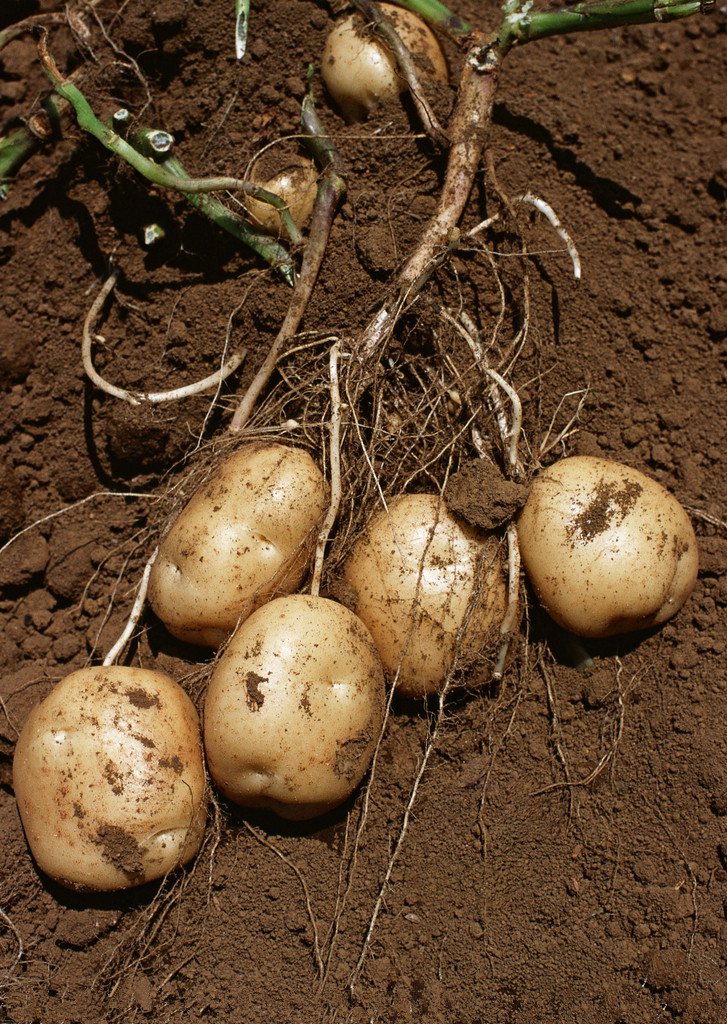
I. Cutting seed pieces and sprouting.Before sowing20days, at about3early month, start sprouting. When cutting potato seed pieces, each piece must have at least one eye.10~15pieces/jin is appropriate. After cutting, use wood ash to dry-dress or carbendazim powder at1:200times diluted with water to soak the seed pieces for sterilization and disinfection. After the seed pieces are air-dried, start sprouting in the seedbed. There are two methods: one is to sprout with sand in a corner of the room at a room temperature above15°C, one layer of sand and one layer of seed pieces; the other is to dig a pit outdoors in a ventilated, sunny spot running east-west for sprouting, with a pit depth of about25cm, one layer of sand and one layer of seed pieces,3layers is appropriate, then cover with an arched shed film, and add straw curtains at night for insulation. During the sprouting period, the above two methods require sprinkling water1~2times to prevent drying out. When the sprouts grow to0.5~1.0cm in length, begin sowing.
II. Land preparation and trenching.Before planting, check the soil moisture. If the moisture is poor, consider irrigating the trenches to build moisture; the moisture-building period should be7~10days before planting. Potato planting generally uses double-trench planting. When trenching, a wide row of50cm and a narrow row of40cm can be used.
III. Sowing and covering with film.From the Spring Equinox to Qingming is the best period. What should be specially noted here is that virus-free potatoes can be sown earlier, completed before the Spring Equinox, and the plant spacing can be controlled at20cm. Before sowing, first spray along the trench with phoxim at1:10000times diluted with water to prevent underground pests. Organic fertilizer can be directly scattered into the trench or spread when preparing the land; chemical fertilizer can be applied into the trench or scattered between the seed pieces(note that it must not come into direct contact with the seed pieces). When sowing, there are two methods for placing the seed pieces into the trench: one is with the sprout facing down; potatoes grown this way have long roots and strong seedlings, fewer potatoes but larger tubers, but the seedlings emerge2~3days later; the other method is with the sprout facing up; potatoes grown this way have relatively shorter roots, smaller but more numerous potatoes, and the seedlings emerge2~3days earlier. After planting is finished, take soil from both sides of the wide row to cover the potato trench and the space of the narrow row well, rake it level, cover tightly with microfilm, and press it firm.
IV. Seedling emergence, ventilation, and seedling-stage management.After Qingming, about20days after sowing, seedlings will emerge from the soil. At this time, break open the microfilm at the seedling location for ventilation to prevent steaming the seedlings. When the seedlings grow to10cm in height, press the film around the seedlings firmly with soil to preserve moisture and suppress weeds. Potatoes should not be watered in the early stage of growth; water only after flowers appear. If there is drought without rain, water once every10days; generally2~3waterings are enough for maturity, and stop watering10days before harvest. During the seedling stage, prevent pests such as aphids or thrips.
V. Reasonable fertilization.Potatoes like farmyard manure; per666.7sq m,4000~5000jin is appropriate. At the same time, when applying chemical fertilizer appropriately, nitrogen, phosphorus, and potassium should be used in combination. Potatoes have a large demand for potassium. The scientific and reasonable fertilizer application ratio of nitrogen, phosphorus, and potassium is1.85:1:2.1. Potatoes like to absorb ammonium nitrogen and absorb relatively more sulfur. According to experiments, for every additional1kg of potassium sulfate fertilizer applied, potato yield can be increased by100~150kg.