Detailed Guide to Using Plant Growth Regulators
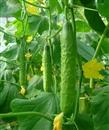
What is the use of plant growth regulators on cucumbers? How can they be used well? 1. They help improve seed vigor and cultivate strong seedlings. (1) Soak cucumber seeds in 0.05 mg/L brassinolide for 24 hours to promote early emergence, uniform emergence, and strong seedlings, and to increase the resistance of sprouts and seedlings. (2) Use Ai...
Use of plant growth regulators on various crops:
I. Application on solanaceous vegetables
1. Treatment at the seedling stage Seeds can be soaked for 6 hours in 500 mg/kg daminozide or 500-1000 mg/kg paclobutrazol, and the inhibitory effect lasts for 1 month. For 1 sq m of seedbed, 1 kg of a 250-500 mg/kg chlormequat dilution can be poured on, or 1000-4000 mg/kg daminozide or 300 mg/kg ethephon dilution can be sprayed on the leaves, and the effects are all very obvious. Generally after 7 days, seedling growth slows, leaf color becomes dark green, stems become short and thick, the root-to-shoot ratio increases, and the plant becomes dwarfed; flower bud differentiation is not affected, and a dynamic balance between vegetative growth and reproductive growth at the same stage can be achieved.
2. Treatment at the transplanting stage Soak transplanted seedlings in a dilution of 10-15 mg/kg gibberellin and 10 mg/kg rooting powder No. 4. The seedling recovery period is shortened, new roots form earlier, the product can be marketed about 10 days earlier, and yield can increase by about 15%.
3. Treatment after transplanting At the early flowering stage, spray the whole plant twice with 50-100 mg/kg paclobutrazol or 50-100 mg/kg mepiquat chloride dilution, with an interval of 10-15 days. This can shorten internodes by about 1/3, significantly increase the fruit-setting rate compared with the control, and promote fruit development.
4. Treatment at the flowering stage The flowering stage of solanaceous vegetables is the period when the contradiction between vegetative growth and reproductive growth is most likely to intensify, and it is also the most critical period for applying plant growth regulators. To prevent tomato flower drop. Before flowering or 1-2 days after flowering (trumpet-flower stage), dip individual flowers with 15-20 mg/kg 2,4-D. When 3-4 flowers in a truss have already opened, spraying the whole truss with 30-50 mg/kg 4-CPA gives very good results. When using 2,4-D, note that only half-open or just-opened flowers can be treated; unopened flowers must not be treated, and treating faded flowers is ineffective; each flower can only be treated once. When using 4-CPA, it is best when single flowers that have opened account for 60%-70% of the whole truss. Both should be used on strong seedlings, and the concentration should be appropriately increased as the temperature decreases, but one must not decide arbitrarily on one's own. To prevent green pepper flower drop. The "three drops" disorder of green pepper has complex physiological and cultivation causes, but using plant growth regulators will achieve certain results. Through tests on 2,4-D and 4-CPA, there were effects but also obvious phytotoxicity. According to other references, spraying flowers with 50 mg/kg naphthaleneacetic acid is recommended.
5. Fruit treatment After tomatoes are insufficient in weight and volume and their color turns white (white back), pick them, soak the fruit in 2000-4000 mg/kg ethephon for 1 minute, remove them, and place them in a 20-25°C environment for 2-3 days, after which they all turn red, 5-7 days earlier than in the field. Compared with methods introduced in other references such as smearing fruit on the plant and spraying fruit, considering uniformity of coloring, negative effects on leaves, and operability, the fruit-soaking method is recommended.
II. Application on cucurbit vegetables Greenhouse cucurbits generally include cucumber, zucchini, bitter melon, chayote, and so on. These vegetables are monoecious with unisexual flowers, rely entirely on wind and insects for pollination, and can set fruit parthenocarpically. This determines the great potential for using plant growth regulators.
1. Inducing female flowers in cucumber We know that when the first true leaf of cucumber unfolds, the growing point has already differentiated 12 nodes, and the axillary flower buds of the lower 9 nodes have already differentiated and formed, but the sex type is not yet determined. When the 7th true leaf unfolds, flower bud differentiation has reached 23 nodes, and by node 16 flower sex has been determined. The number of female flowers directly determines early and mid-season yield. According to tests, spraying the whole plant twice with 150-250 mg/kg ethephon at the 2-5 true-leaf stage, with an interval of 8-10 days, significantly increased the number of female flowers on the main vine and inhibited the number of male flowers, laying a foundation for increasing yield. However, not every female flower will necessarily become a cucumber, and water and fertilizer management and supporting cultivation techniques are also required.
2. Preventing fruit abortion Because greenhouse cucurbits have relatively low temperatures inside the greenhouse, short sunshine duration, and poor natural pollination, if cultivation measures are also not ideal, fruit abortion is most likely to occur. It is recommended to spray with a 200-400 mg/kg gibberellin dilution using a small sprayer. Spraying on the leaves when flowers are about to bloom, are blooming, or when petals begin to wilt can all increase the fruit-setting rate by more than 30%. For zucchini, it is recommended to use 30-40 mg/kg 2,4-D before 9 a.m. to dip the base of the flower stalk and the base of the petals of flowers opening that day with a brush, and the effect is very significant.
III. Application on leafy vegetables According to the local characteristic that leafy vegetables focus on increasing yield and bringing them to market earlier, tests were carried out on several regulators, and gibberellin had obvious effects in both increasing yield and promoting early maturity.
Click to view more regulator application techniques
Click to view more pesticide application techniques
Click to view more vegetable growing techniques
Click to view more fruit growing techniques