Improved Rapeseed Cultivation Method - High and Stable Yield, Low Cost Cultivation
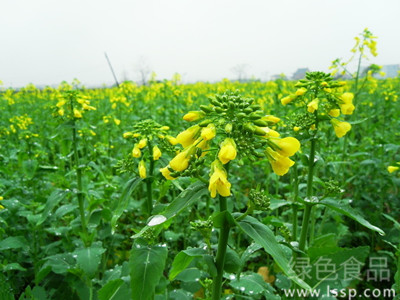
After years of research and experimentation, a series of improvements have been made to rapeseed cultivation methods, achieving good results of high and stable yield with low cost.
I. Seedling Raising
(1) Select good varieties: Choose varieties with strong growth before winter, strong resistance to disease, lodging and cold, good yield stability and high yield potential, such as Yangyou No. 5, Yangyou No. 6, Dongyou 18, Huiyou 50, etc. Shilifeng rapeseed needs to be transplanted appropriately early and is not suitable for this cultivation method.
(2) Rotary tillage after sowing: Sow from September 15-20. For each mu of field, use 80 sq m of seedbed, requiring 120 g of seeds, apply 200 kg of manure, 2 kg of monoammonium phosphate, 1.5 kg of potassium chloride. Applying less nitrogen fertilizer helps the seedlings grow strong and makes it easy to establish after transplanting. Spread the seeds and fertilizer evenly directly on the seedbed, and use a rotary tiller for fine rotary tillage. If the soil moisture is high, rotary tillage should be appropriately shallow. After rotary tillage, no leveling or compaction is needed, and no watering is needed in case of drought, which can ensure uniform emergence without clustered seedlings. No thinning is needed, generally 100-130 seedlings emerge per sq m.
(3) Moderate chemical control: At the 3-leaf stage, use 15% paclobutrazol at 1200 times dilution for chemical control, which can significantly reduce tall-leg seedlings and bent-root seedlings, and help seedlings establish quickly after transplanting.
II. Transplanting
(1) Do not rush early transplanting: Practice has proven that rapeseed transplanted early before October 20 has a short seedling age, tender and thin leaves, and combined with high temperature, strong light and high evaporation, even if watered once or twice for establishment, most leaves will wither and die, leaving only the heart leaves, with many missing plants and severe weed damage in the field. However, transplanting from late October to early November results in a short recovery period, and can avoid bolting before winter. Before overwintering, the seedlings are strong but not excessive, yellow and withered leaves are significantly reduced, sclerotinia infection is mild, and no weeding is needed in the field before the new year.
(2) Rotary tillage of fertilizer into soil: For each mu of field, use 10 kg each of monoammonium phosphate, urea and potassium chloride, mix and broadcast, then machine rotary till into the soil. No further fertilization before winter.
(3) Appropriately sparse planting: After digging the drainage ditches, open sun-facing furrows for transplanting. Determine density based on variety, seedling condition, soil fertility and transplanting time. Generally 6000-8000 plants per mu, with row spacing of 40-50 cm and plant spacing of 20-30 cm.
(4) Bring pesticide to the field: Before transplanting, spray a mixture of abamectin (or pyrethroid pesticides) and carbendazim to prevent disease and control pests. No further pesticide application before spring.
(5) Do not water for establishment: When lifting seedlings, use a shovel to dig deep into the soil to lift the seedlings, to prevent root damage and stem breakage. Keep as much soil as possible on the roots, and dip the roots in paste-like river mud, transplanting as they are lifted. Choose afternoon or cloudy days for transplanting, press firmly after planting, and do not water for establishment.
III. Management
(1) Heavy application of bolting fertilizer: In early March of the following year, when the stalks bolt to 3-4 cm, broadcast 15 kg of urea per mu in the sun-facing furrows. Combined with weeding, level the sun-facing furrows to cover the fertilizer and earth up the roots.
(2) Chemical control to promote strength: In mid-March when stalks are 30 cm tall, spray 40 g of 15% paclobutrazol plus an appropriate amount of carbendazim per mu to prevent disease and control pests, and promote strength and lodging resistance.
(3) Mixed spraying of fertilizer and pesticide: Perform mixed spraying of fertilizer and pesticide once each at the initial flowering stage and full flowering stage. Each time, use 250 g of 25% carbendazim, 150 g of borax, 150 g of potassium dihydrogen phosphate, 20 mL of abamectin, add 50 kg of water and spray per mu.
IV. Harvest
When most siliques in the whole field turn yellow, all siliques on the main stem flower axis turn yellow, and the seeds turn from green to brown-red, harvest before 10 AM while the dew has not dried, and spread out to dry on the spot. After drying, lay non-woven fabric on the ground and thresh on the spot. The husks and other residues are returned to the field on the spot, saving labor and cost.