Raspberry High-Yield Cultivation and Management Techniques: Teaching You to Grow the Fruit of Life Well
Raspberry High-Yield Cultivation and Management Techniques
Raspberry, also known as fupenzi, fupenzi, shuwopao, maipao (it bears fruit during the wheat harvest season, hence the name), and other names, is a deciduous small shrub of the Rosaceae family. Because its fruit shape and color resemble those of the strawberry but it grows on a tree, it is called raspberry. It is one of the third-generation fruits that have emerged in recent years both domestically and abroad. Raspberry is sweet and sour, pleasant to the taste, and rich in nutrients, with a special, intense aroma. Besides being eaten fresh, it can also be processed into juice, beverages, fruit wine, and so on. Raspberry has wide adaptability and strong growth vigor, and has no special requirements for soil quality. In the year of planting, it can already bear a small amount of fruit, and in the 3rd and 4th years it enters the full production period, with a yield of more than 1,200 kg per mu. Because its fruit is novel and unique, standing out among many fruits, it also has strong market competitiveness and development prospects. Raspberry has strong tillering ability. After the 2nd year of planting, each plant can produce more than ten new tiller seedlings per year, and it can quickly bring barren hills under control. It is a small shrub fruit tree variety with extremely high ecological and economic benefits. Raspberry has very strong adaptability. In our country, except for the Qinghai-Tibet Plateau, it can be planted in most areas. In the north, raspberry can endure low temperatures of -40 to -45°C, and in the south it can be planted anywhere.
Its cultivation and management techniques are as follows:
1. Planting period:Raspberry can be planted in spring or autumn. In principle, spring planting is after the soil thaws and before the seedlings sprout (March—April). During this period, on the premise that the seedlings are kept from sprouting, later planting is better. If spring planting is too early, because the soil temperature is low and the range of temperature variation is unstable, it is not conducive to root growth. In principle, autumn planting is after the raspberry seedlings have matured and become lignified until before the soil freezes (October—December).
2. Planting methods:Raspberry planting methods include single-plant planting and strip planting. Single-plant planting is suitable for scattered open spaces beside homes, as well as for black raspberry, which has weaker tillering ability. For single-plant planting, both row spacing and plant spacing are 2 m. Strip planting is suitable for large-area planting. For strip planting, the row spacing is 2.50 m, the plant spacing is 0.30 m, and there are 330 planting holes per mu. In areas where soil is not mounded for winter protection, the row spacing is 1.50 m, the plant spacing is 0.80 m, and there are 555 planting holes per mu. Whether single-plant planting or strip planting, in order to form a luxuriant clump early and reach a high-yielding clump density as soon as possible, it is advisable to plant 2—3 plants per hole.
3. Planting:Before planting, soak the seedling roots in water for 12—24 hours so that the roots absorb enough water and the survival rate is increased. The planting requirement is deep planting and shallow burying. Deep planting means the seedling roots should be 10—15 cm from the ground surface; shallow burying means that within 30 cm around the seedling, when covering with soil, do not exceed the original soil mark on the branch. The purpose of deep planting is that each year the newly formed rhizomes move upward year by year with the age of the plant, while the roots below age year by year. To ensure normal growth of the plant, deep planting is therefore required. The main purpose of shallow burying is to shorten the seedling recovery period and increase the survival rate.
When planting, first dig the planting holes, hold the seedlings upright in the holes, and take care to spread out the root system. Then cover with soil up to the original soil mark, tread the covering soil firmly so that the roots are in close contact with the soil, and finally water thoroughly in one application.
After spring planting of raspberry, because the plant's nutritional center is in the underground roots rather than above ground, it generally takes 1 to 2 months before basal shoots can emerge. This is the particularity of raspberry that differs from other fruit trees, so the survival rate of raspberry should be investigated 2 months after planting. After autumn planting, the raspberry root system resumes growth before the soil freezes, while at this time, because of low temperature and short daylight above ground, the buds have already entered a dormant state and cannot sprout. This not only increases the survival rate but also promotes production in the 2nd year. Therefore, the survival rate of autumn-planted raspberry is 1—2 percentage points higher than that of spring-planted raspberry, which is determined by the special root system of raspberry.
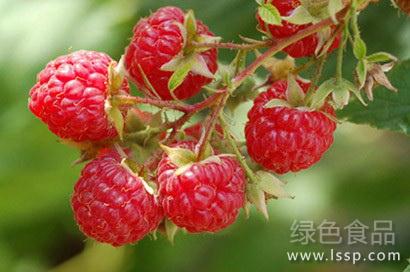
Raspberry growing vigorously and pleasingly
4. Trellising and tying:Although among raspberries all varieties except blackberry are upright types, because raspberry canes usually grow for only 2 years, the canes are relatively slender compared with those of other fruit trees. When the canes grow to 1.50 m, they easily become arched and touch the ground, especially during the fruiting period, and even more so under the heavy pressure of the fruit. When canes touch the ground, first the fruit becomes contaminated, affecting fruit quality and economic benefits; second, it also brings inconvenience to management such as soil, fertilizer, water, and harvesting. Therefore, raspberry needs trellising and tying. Trellising and tying can increase the leaf area coefficient, change flat fruiting into three-dimensional fruiting, make cane distribution uniform, and improve ventilation and light conditions. This is also one of the important measures for increasing raspberry yield and achieving a bumper harvest.
Trellising and tying are very simple. Within the row, set a post every 5—10 m, with a height of 1.20 to 1.50 m, and stretch 2 lines of wire. The upper wire is fixed at the top of the posts, and the lower wire is 1 m from the ground. Then train and tie the canes onto the wires in a fan shape.
5. Pruning:Like other fruit trees, if raspberry is to achieve stable and high yields, it must have a sufficient and reasonable amount of canes, which requires pruning.
The 1st pruning is planting-time pruning in early spring. Overly dense, thin, weak canes and damaged canes should be cut off flush with the ground. When the new shoots of the current year grow to 40—60 cm, for plants with lower density, pinching back by 10 cm can be carried out to promote lateral buds to sprout new canes and increase the number of canes.
The 2nd pruning is pruning of basal shoots (that is, new shoots of the current year). Production practice shows that cutting and retaining basal shoots within 1.30—1.50 m is most suitable. This length not only promotes the growth of fruiting mother canes and increases yield, but also enables complete flower bud differentiation of basal shoots in the 2nd year. Therefore, when basal shoots exceed 1.50 m, they should be pruned. Each year, 6—8 vigorous basal shoots can be selected and retained per plant, and the rest cut off. This is a relatively reasonable clump density.
The 3rd pruning is after harvest is finished, when the fruiting mother canes should be thinned out flush with the ground.