Winter lettuce greenhouse cultivation technique, ready for market around the Spring Festival
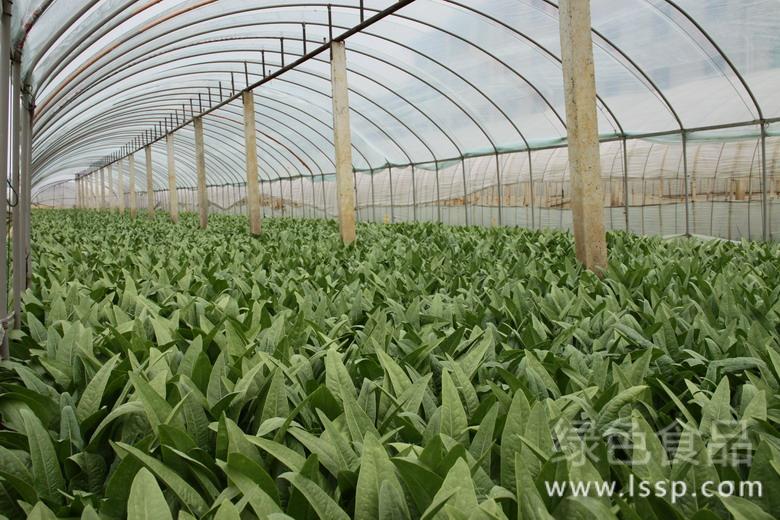
Lettuce
After the lettuce plant grows larger, its cold resistance declines and it is prone to frost damage, so overwintering lettuce must be cultivated in greenhouses; in warm-winter areas, cultivation with plastic film mulching or even open-field cultivation can also be used. Generally sown from mid-to-late September to early October, it is ready for market around the Spring Festival, with a yield of 1500-2500 kg per mu.
Sowing and raising seedlings. Choose late-maturing varieties. Use shade netting to cover the ground to lower temperature and retain moisture; remove the covering as soon as seedlings emerge, thin once after seedlings are uniform, keeping plants 3-4 cm apart, appropriately control watering, apply one topdressing of 0.3% urea solution, and cultivate strong seedlings.
Greenhouse transplanting. The seedling age of overwintering lettuce should be controlled at 30-40 days, with more than 4-5 leaves, and transplanting is done from late October to November. Plant spacing 33-40 cm; generally pointed-leaf types are planted more densely than round-leaf types. Before transplanting, plow and sun-dry the soil for 5-7 days, and apply decomposed organic fertilizer along with the plowing. Lettuce planted immediately after plowing without sun-drying the soil has lower yields.
Heat preservation and frost protection. After transplanting, cover the greenhouse film early, but on clear warm days lift the side film and both ends for ventilation; during frosty weather when a cold wave arrives, close the greenhouse to keep it warm. After January there are many overcast, rainy, and snowy days, so attention must be paid to closing the greenhouse for warmth; at night, straw curtains can be added around the greenhouse or a small tunnel can be placed inside the greenhouse for frost protection. After the fleshy stem begins to swell, maintain daytime temperatures of 18-20°C and nighttime temperatures of about 10°C.
Topdressing and watering. After transplanting and establishment, fertilizer and water management should follow the principle of controlling in winter and promoting in spring; before covering with the greenhouse film, generally apply 2-3 light applications of manure water, and control temperature to prevent excessive vegetative growth. One month after transplanting, apply a heavy fertilizer: 10-15 kg urea per mu, 10 kg potassium fertilizer or 50 kg plant ash, and foliar spray of 0.2% monopotassium phosphate or 2000 kg of 30% decomposed manure water. Keep the soil moist throughout the growing period, and control watering as harvest approaches.
Regulation with plant growth regulators. To control excessive vegetative growth, about half a month after transplanting, spray once with paclobutrazol at a concentration of 100-150 mg per kg or chlormequat at a concentration of 300-500 mg per kg. If the tender stem still elongates rapidly, or if market reasons require appropriately delaying the harvest, spray chlormequat again after 10-15 days to make the fleshy stem grow thicker and sturdier. 15-20 days before market, spray the whole plant with gibberellic acid at a concentration of 20-25 mg/kg, which can increase yield by 10%-20%.