Winter Management Techniques for Fruit Mulberry Trees with a Double Harvest of Fruit and Leaves
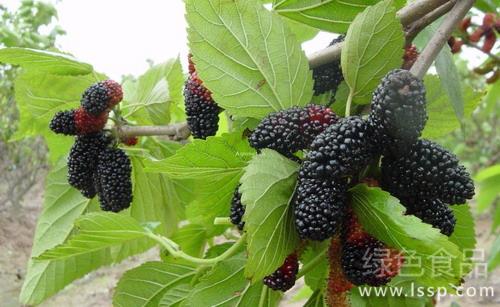
Fruit Mulberry Tree
From winter to early spring, properly pruning the tips and training the branches of fruit mulberry trees will greatly increase the fruit mulberry yield and mulberry leaf quantity in the second year, achieving higher economic benefits.
Tip pruning means cutting off the part of the branch tip where the xylem is not fully developed after the fruit mulberry tree has naturally shed its leaves. Tip pruning can reduce nutrient consumption, make the branches solid, enhance cold resistance, increase the sprouting rate and fruit-setting rate of mulberry trees in the following spring, and can increase spring leaf yield and summer fruit quantity.
1. Timing of tip pruning: If pruned too early, the mulberry tree has not stopped growing, and when the temperature rises, the winter buds on the middle and upper parts of the branches will sprout in autumn, which instead consumes nutrients; if pruned too late, due to respiratory consumption, part of the nutrients in the branches has already been lost, reducing the effect of pruning. The suitable period should be from after the mulberry tree naturally sheds its leaves in November to the early spring period.
2. Length of tip pruning: The length of tip pruning depends on the mulberry variety and branch length. For varieties with short branches, dense internodes, and a high sprouting rate, tip pruning should be shorter; otherwise, tip pruning should be longer. Generally, for branches over 1.5 m, cut off 1/3 of the branch length; for branches 1.3—5 m long, cut off 1/6 of the branch; for those around 1 m, remove the non-lignified part.
3. Points to note: When pruning tips, leave a good bud at the cut. Make the cut 1 cm above the bud at the cut, cutting it into a horseshoe-shaped slope. The cut top tips should be picked out and burned in time, which can kill some pests and diseases.
Training fruit mulberry trees means using mulberry shears or saws to remove the useless parts on the mulberry tree, using lime to plug tree holes, etc. Winter training can reduce unnecessary nutrient consumption, eliminate pests and diseases, strengthen tree vigor, make the tree shape neat, and at the same time facilitate later shaping and pruning.
⟧ Winter training of fruit mulberry can be carried out after the mulberry tree sheds its leaves, after branch pruning is completed, and before the sap flows in early spring. This period is the dormant period of the mulberry tree, with little physiological impact on the mulberry tree; at the same time, it is also the period when the most pests and diseases lurk in the trunk, which can reduce pests and diseases. When pruning, the tools should be kept close to the trunk for cutting, and the cut should be smooth, without damaging healthy branches, without splitting or cracking, which is beneficial for wound healing and the sprouting of latent buds. The pruned diseased and pest branches, etc. should be cleared out of the mulberry orchard to thoroughly eliminate the source of pests and diseases.