Symptoms and control techniques of rice stripe virus disease
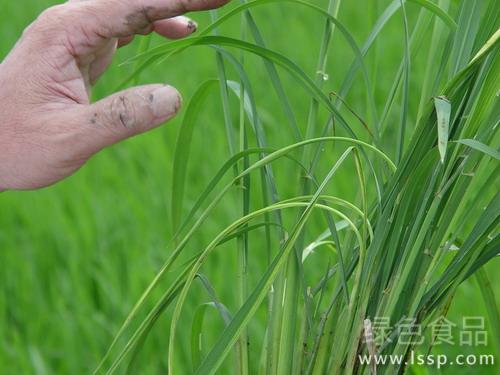
Rice stripe virus disease
Rice stripe virus disease is a viral infectious disease caused by the small brown planthopper (Laodelphax striatellus). In recent years, the occurrence of this disease in our area has shown an upward trend. At present, in the main rice-producing areas of our area, the cumulative affected area is nearly 100 mu, the rate of diseased plants in the field is 2%-10%, and it shows a trend of epidemic spread. Rice stripe virus disease causes severe damage and great losses. In generally affected fields, the yield loss is 20%-30%, and severely affected fields may suffer total crop failure.
I. Disease symptoms
In the early stage of the disease, yellow-green stripes begin to appear from the central leaf, which gradually curls and bends downward; the diseased plant gradually becomes dwarfed, the leaves lose chlorophyll and become greenish white, and finally the leaves fade and die. Disease onset at the tillering stage: chlorotic yellow spots first appear at the base of the leaf below the central leaf, then expand to form irregular yellow-white stripes, while old leaves do not show symptoms. Disease onset after jointing: yellow-green stripes appear on the lower part of the flag leaf, without dead heart; diseased plants often have empty panicles or small, deformed, unfilled panicles.
II. Transmission routes and disease conditions
Rice stripe virus is transmitted only by the vector insect Laodelphax striatellus, and not by other routes. Once the vector insect Laodelphax striatellus acquires the virus, it can carry the virus for life and transmit it through eggs. Besides infecting rice, the virus also harms more than 50 species of plants in the grass family, including wheat, barley, oats, corn, foxtail millet, broomcorn millet, Alopecurus aequalis, and Setaria viridis, but except for rice, other hosts play little role in the infection cycle. The virus overwinters in the body of virus-carrying Laodelphax striatellus and becomes the main primary infection source. Nymphs overwintering in wheat and barley fields, after emerging as adults, reproduce in the original wheat field, then migrate to rice seedling fields or main fields to transmit the virus, cause damage, and reproduce. Rice is susceptible from the seedling stage to the tillering stage. The longer the leaf age, the longer the incubation period, and resistance gradually increases as the plant grows. The occurrence of rice stripe virus disease is directly related to the population of Laodelphax striatellus and the rate of virus-carrying insects. The more Laodelphax striatellus there are, the more severe the disease.
III. Control methods
1. Select disease-resistant varieties: Selecting disease-resistant varieties is the fundamental means of controlling the occurrence of rice stripe virus disease. Among the rice varieties promoted and planted in our area in recent years, Chujing 24 and Chujing 29 are relatively resistant to the disease.
2. Persist in crop rotation and stubble adjustment, improve soil fertility, and improve soil aggregate structure.
3. Apply more organic fertilizer, enrich the soil, appropriately control the amount of chemical fertilizer, and pay attention to increasing the application of phosphorus, potassium, and silicon fertilizers to promote robust rice growth and enhance resistance to the disease.
4. Clear weeds around the fields. Weeds are an important place for Laodelphax striatellus to live. It is necessary to intensify the removal of weeds around rice seedling fields and main fields. Eliminate the living environment of Laodelphax striatellus, cut off the parasitic chain, and reduce disease occurrence.
5. Chemical control. Chemical control is one of the important measures to effectively control the number of Laodelphax striatellus and prevent virus transmission. It is necessary to adhere to the pesticide control strategy of “cut off the virus chain, control insects and disease.” Adopt the method of treating seedling fields to protect main fields, and treating the early stage to protect the later stage, controlling the reproduction number of Laodelphax striatellus at multiple links and preventing virus transmission. For pesticides, 25% pymetrozine suspension concentrate 24 grams/mu or 40% Fogo water-dispersible granules 8 grams/mu can be selected, mixed with 50 kg of water for spraying, to control planthoppers, thereby achieving the purpose of disease prevention. Occurrence and control techniques of rice stripe virus disease