What to Do When Radishes Turn Pithy? Seven Steps to Preserve Their Food Value
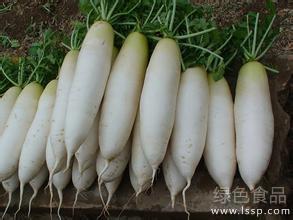
Daikon radish
Pithiness in radishes is a common physiological disorder of the fleshy root. Once it develops, not only does the weight decrease and the starch and sugar content drop, but the tissues also become soft, the flavor grows bland, the food value is reduced, and the roots can no longer be stored. To prevent and control pithiness in radishes, the main points are as follows:
First, choose good varieties. Select small-type radish varieties with dense flesh that are not prone to pithiness.
Second, sow at the right time. Sow at the proper time and do not rush to sow early. The folk saying goes, "Radishes in the first fu, vegetables in the second fu." In recent years, many people have blindly changed this to "Radishes before the fu, vegetables in the first fu," advancing the sowing date by more than 1 week, which is also the main reason for the widespread pithiness of radishes in various regions.
Third, plant at a reasonable density. For large varieties, the row spacing is generally 50-60 cm and the plant spacing 20-30 cm; for medium varieties, the row spacing is 40-50 cm and the plant spacing 15-20 cm; for small varieties, the plant and row spacing is 8-10 cm.
Fourth, fertilize scientifically. Fertilization should follow the principle of giving priority to base fertilizer and supplementing with topdressing, with attention to a rational balance of the three key elements nitrogen, phosphorus, and potassium, and scientific fertilization. For varieties with sufficient base fertilizer and a relatively short growing period, less topdressing can be applied; large varieties have a long growing period, so topdressing can be applied lightly but frequently, at the seedling stage, the leaf-growing stage, and the fleshy root enlargement stage respectively, with 10-15 kg of urea, 3-5 kg of superphosphate, and 15-20 kg of potassium sulfate per mu.
Fifth, water reasonably. Control soil moisture and prevent it from becoming too dry or too wet. Use the method of "water thoroughly in drought, water evenly on cloudy days" and keep soil moisture at 70%-80%. Water demand is high in the middle and late growth stages, so water should be supplied adequately, but the amount of watering must not be too much, to prevent excessive top growth. The folk practice is: "Do not water if the soil is not dry; water at once when the soil turns white."
Sixth, spray to prevent pithiness. When radishes enter the "root-splitting stage," spraying the leaves with a mixture of 5% white sugar, borax, and an appropriate amount of naphthaleneacetic acid can effectively prevent pithiness. Generally, half a month before harvest, spray a 50 mg/kg gibberellin solution, and in the late growth stage spray a 10 mg/kg naphthaleneacetic acid solution 2 times, with an interval of 10-15 days each time; this neither affects the growth of the fleshy root nor prevents pithiness, and delays maturity. If, when spraying 10 mg/kg naphthaleneacetic acid, 5% sucrose and 5 mg/kg borax solution are added and the three are mixed and sprayed, the effect of preventing pithiness is even better.
Seventh, store scientifically. The suitable storage temperature for radishes is 0-2°C, and the air humidity is 95%.