Key Cultivation Practices Affecting High Yield of Winter Melon: Late-Crop Winter Melon Offers High Returns
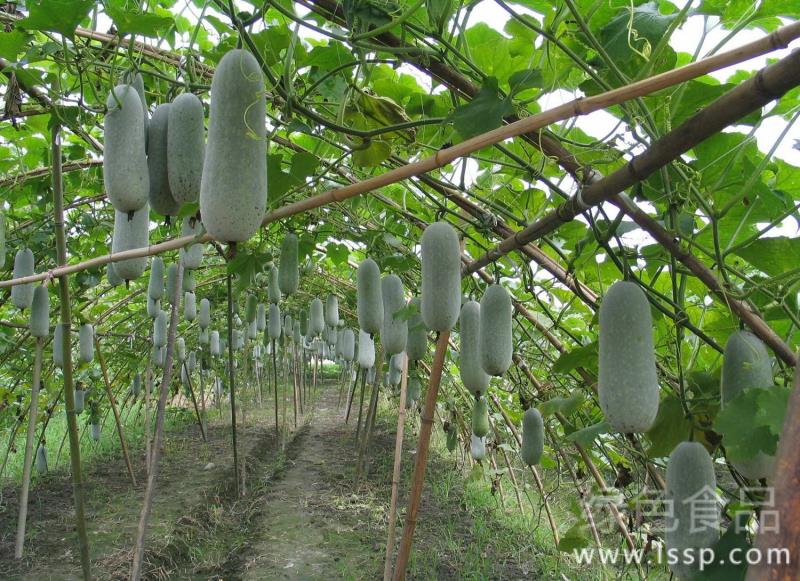
Winter Melon
Late-crop winter melon generally yields more than 4000 kg per mu, is suitable for autumn delayed fresh-keeping storage, and brings relatively high market returns. However, because its growing period falls in the hot, humid season, the contradiction between fertilizer and water supply and growth and development is intensified. In particular, whether or not pruning is done is the key to high yield of winter melon.
1. Field selection. Winter melon should not be planted continuously on the same plot of land, nor should it be planted in low-lying land. Relatively fertile and neutral soil should be chosen for cultivation. Late winter melon is generally sown in June-July, with about 200 g of seed per mu.
2. Transplanting at the right age. When winter melon seedlings reach 30 days of age and have grown two true leaves and one heart leaf, choose strong seedlings with well-developed root systems, thick stems, short internodes, thick and dark leaves, and no damage for transplanting. Generally, when only the main vine is retained, 800-900 plants are planted per mu; when two vines are cultivated, 400-500 plants are planted per mu.
3. Reasonable topdressing. The principle for topdressing late winter melon is "light and dilute early, heavy and concentrated in the middle, and supplementary in the later stage." After the seedlings have established, apply about 100 kg of 20% human and animal urine as a topdressing. When the melon grows to 4-5 kg, apply 4-5 kg of human and animal urine or 0.1 kg of urea per hole; when the melon grows to 15-20 kg, apply 5-6 kg of human and animal urine or 0.2 kg of urea per hole. After that, if the leaf color becomes lighter due to lack of fertilizer, apply another 2-3 kg of human and animal urine per hole. When the vines reach 1 m in length, carry out one intertillage.
4. Pruning and vine retention. Pruning is an effective measure to increase yield and ensure uniform melon size. Generally, when the main vine is retained for cultivation, begin retaining melons when it has grown to 20-24 leaves, and remove all earlier melons. When two vines are retained for cultivation, the position for retaining melons on the main vine is the same as above, and melons retained on the side vine must not be fewer than 10 leaves. All branches before the young melon should be cut off to help concentrate nutrients for the growth of the young melon. After fruit set, prop the melon promptly, and upright propping is best.
5. Supplementary pollination. Artificial supplementary pollination can increase the fruit-setting rate. Choose male flowers that have just opened in the morning, remove the corolla, and lightly smear the anthers onto the stigma of the female flower.
⟧ 6. Control of diseases and insect pests. The main diseases and insect pests occurring on late winter melon include damping-off, fusarium wilt, phytophthora blight, aphids, and white grubs. For damping-off, use 75% chlorothalonil 1000-fold solution or 70% dexon wettable powder 1000-fold solution; for fusarium wilt, use 50% carbendazim 500-fold solution or 20% tolclofos-methyl EC 900-fold solution; for phytophthora blight, spray leaves or drench roots with 75% chlorothalonil 600-fold solution or 50% metalaxyl-copper wettable powder 600-fold solution, drenching 0.3-0.5 L per plant, once about every 10 days, with 2-3 consecutive treatments giving good results; for aphids, use 40% dimethoate 800-1000-fold solution or 90% trichlorfon crystal 1000-fold solution. For white grubs, use 50% phoxim 1000-fold solution or 1000-fold trichlorfon solution for root drenching.