Strengthen management of newly planted apple orchards in winter, all the technical key points are here
Orchard renovation
In recent years, fruit prices have continued to rise, fruit growers' enthusiasm for developing fruit trees has grown ever higher, and the area of newly planted apple orchards has continued to expand. To make these orchards take shape early, bear fruit early and produce results early, management this winter and next spring is the key to success. Once they become "small old trees," no amount of additional fertilizer or intensified management will easily restore them to vigor.
1. Topdressing. "A crop's glory depends entirely on fertilizer." Fertilizer is the most critical factor. Fertilization should be based mainly on organic fertilizer, supplemented by chemical fertilizer. Apply 20-30 kg of organic fertilizer such as cow manure, pig manure or chicken manure per tree, plus 0.5-1 kg of compound fertilizer. Dig 4 deep pits per tree measuring 25 cm x 25 cm x 30 cm (length x width x depth). When applying, be sure to mix the fertilizer and soil evenly.
⟧
2. Making tree basins. Along the planting rows, make tree basins 1 m from the trunk, so the root system has enough space to grow and watering is easier.
3. Watering. After fertilizing and making the basins, immediately water thoroughly once so the fertilizer takes effect as early as possible.
⟧
4. Whitewashing. Whitewashing the trunk is an effective measure to prevent insects and prevent dieback from drying. The formula is 5 kg water + 1 kg quicklime + 0.15 kg salt, applied to the main trunk.
⟧
5. Mulching with grass. Grass mulching not only resists drought and preserves water, but also increases soil organic matter. It plays an irreplaceable role in strengthening trees and expanding the canopy, and crop straw (corn and wheat straw, peanut vines, etc.) is cheap, while fallen leaves and weeds are abundant resources. It can be pressed into the tree basins along the planting rows, with a thickness of 5-10 cm as suitable. It is best to use semi-rotted or rotted straw and weeds that are not prone to fire.
⟧
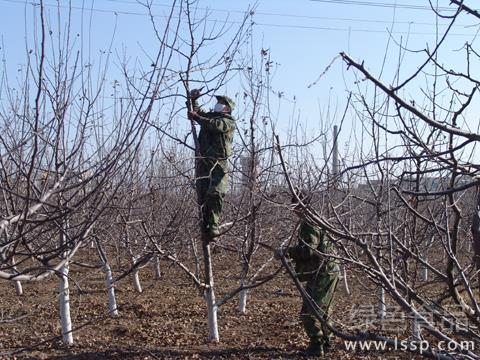
6. Pruning. Just before bud break, severely cut back all main branches and cut back the central leader leaving it long at a plump bud. If the central leader of the apple tree is leaning, use a pole and rope to straighten it. Wounds from early pruning should be coated with wound healing agent for protection.