Scientific Light Management Methods for Fruit Trees in Greenhouses
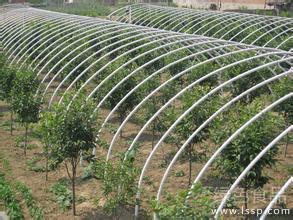
Greenhouse fruit trees
Greenhouse fruit trees need good light for growth, but the light intensity inside a greenhouse is generally only 60%-70% of natural conditions. At the same time, natural daylight hours in winter are short and the intensity is poor, which cannot meet the growth needs of fruit trees. Therefore, to achieve high yield and high efficiency in greenhouse fruit tree cultivation, the light problem inside the greenhouse must first be solved.
1. Choose the right greenhouse film and keep it clean
For the greenhouse film, it is best to choose films with good light transmission such as polyvinyl chloride anti-drip long-life film and polyvinyl chloride fog film. Anti-drip film can increase light transmission by 20%-30%. For dust, debris and snow covering the greenhouse film, a broom, a wooden pole with cloth strips tied to it, or a motorized sprayer can be used to clean it promptly, which can help enhance light.
2. Selection of tree species and planting
Tree species with small tree bodies should be selected for planting. To improve the utilization rate of light energy, trees should be planted in north-south rows with high-ridge cultivation. The tree population should have taller trees in the north and the shortest trees in the southernmost part, forming a slope shape that is high in the north and low in the south.
3. Shaping, pruning and ventilation for light penetration
For the trunk-setting height of saplings, trees in the front part of the greenhouse should be lower and trees in the back part should be higher. For the tree shape, it is best to cultivate one main branch each along the east-west direction to form a "Y"-shaped two-main-branch tree form. Through pruning, build a tree structure that allows ventilation and light penetration, so that all types of branches in the canopy are evenly distributed.
4. Increase light
Remove the straw covering 1 hour after sunrise and cover it again after sunset. During continuous cloudy days, snowy days and insufficient light, supplementary light sources should be installed, and lighting fixtures that increase light should be used (such as high-pressure sodium lamps, red light lamps, incandescent lamps, fluorescent lamps, etc.). For example, if incandescent lamps are used, at least 2 500-watt incandescent lamps should be installed in one greenhouse. Starting from the leaf expansion stage of the fruit trees, turn on the lights to supplement light before removing the covering in the morning or after covering in the evening. The daily supplementary lighting time should not exceed 3 hours.
5. Lay reflective film and hang reflective curtains
Laying reflective film can increase the average coloring index by 25%-30%. Generally, reflective film is laid 20-25 days before fruit coloring. The reflective film should be laid along the direction of the tree rows, spread flat on both sides of the trees. The outer edge of the reflective film should be aligned with the outer edge of the tree canopy to fully bring out the effect of the reflective film. Reflective film can also be used as a reflective curtain, attached and hung on the back wall inside the greenhouse, which can increase light by 20%-30%.