Want high yields from film-mulched peanuts in spring? Pay attention to these five key points
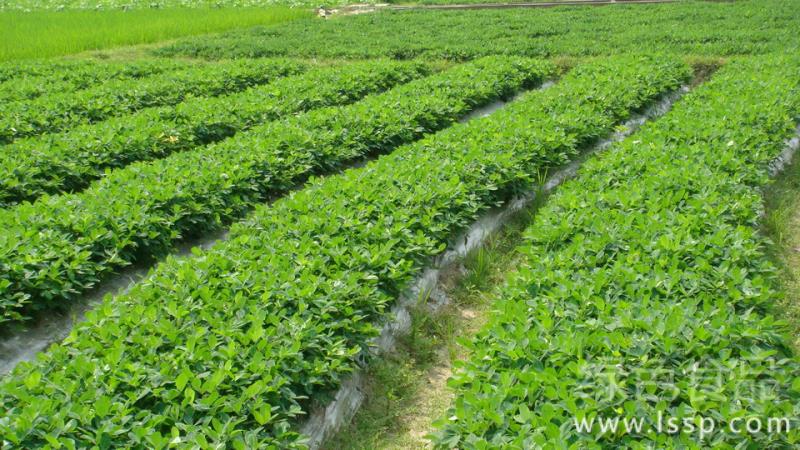
Peanut cultivation
Film-mulched peanuts are grown on a relatively large area in the main peanut-producing regions of our province, such as central and southern Hebei and eastern Hebei, and they are also an important cultivation model in peanut production. Using film-mulch cultivation technology allows peanuts to be sown earlier, increases yields, brings them to market earlier, raises the multiple cropping index, and increases planting returns. Below is an introduction to several issues that should be noted in the production of film-mulched spring peanuts.
1. Choose suitable soil. The peanut is an oil crop tolerant of drought and poor soil, and it especially prefers sandy land with good permeability and a large day-night temperature difference, but purely sandy land has poor fertility, which has a relatively large impact on peanut yield. Film-mulched spring peanuts have high yields and a greater demand for fertilizer. To maximize peanut yield, the plots for growing film-mulched spring peanuts should preferably be sandy loam soil with relatively fertile texture.
2. Choose suitable varieties. Film-mulched spring peanuts have a relatively favorable growing environment. Film mulching can raise the temperature of the soil where the root system is located, has strong moisture-conserving capacity, and gives high fertilizer use efficiency. The peanut root system is well developed, and its absorption and use efficiency of nutrients is also relatively high, so the yield increase in peanuts is relatively significant. To improve planting returns, spring peanuts grown under film mulch should be chosen from medium- and large-fruited peanut varieties with relatively large yield-increasing potential, relatively high yield, and strong disease resistance, such as Jihua No. 2, Jiyou No. 4, Luhua 11, Huayu 16, Huayu 18, and other varieties.
3. Sow at the right time. In production, two misunderstandings are often encountered: one is arbitrarily advancing the sowing date, and the other is delaying the sowing date. If film-mulched peanuts are sown too early, seedlings are prone to freezing damage. Because early spring temperatures are unstable and rise and fall unpredictably, late spring cold spells and cold waves pose a great threat to early-sown peanuts. In mild cases, there are gaps and broken rows; in severe cases, the crop is destroyed. If the sowing date is delayed, the role of film mulching cannot be fully brought into play, and the market period is correspondingly postponed, which affects growers' returns. In an average year, the sowing date for film-mulched spring peanuts is about half a month earlier than that for open-field spring peanuts. In the central and southern Hebei region, it is generally best from April 15 to 20, and in the eastern Hebei region it is correspondingly delayed by one week.
4. Achieve balanced fertilization. The peanut is a high-yielding oil crop with a relatively large demand for fertilizer. Because it has its own nitrogen-fixing ability, its demand for nitrogen fertilizer is not very large, but its demand for phosphorus and potassium fertilizer is relatively large. For film-mulched spring peanuts to achieve high yields, a sufficient fertilizer supply must be ensured. Organic fertilizer and chemical fertilizer should be used in combination, with all the organic fertilizer applied as base fertilizer. After seedling restraint ends, apply quick-acting nitrogen fertilizer once, 15 kg of urea per mu, and at the pod-setting stage apply 10 kg of compound fertilizer. For an ordinary plot, apply 5,000 kg of farmyard manure per mu and 30 kg of potassium sulfate compound fertilizer as base fertilizer in a single application. Increasing calcium fertilizer can effectively prevent pod rot disease and black plaster spot, so add 50 kg of calcium superphosphate fertilizer per mu. Adding 1 kg each of boron fertilizer and zinc fertilizer can significantly increase the fruit-setting rate and improve the plumpness of the pods.
5. Master the suitable density. The planting density of film-mulched spring peanuts should be neither too low nor too high. Too low will affect yield, while too high will reduce the pod-setting rate per plant, waste seed, and lower yield. In production, the commonly used cultivation model is two rows under one film, with a row spacing of 30 cm, a plant spacing of 15-18 cm, a density of about 10,000 hills per mu, two seeds per hill, and a seeding rate of about 16 kg per mu.