Fertilizer and Water Management Measures for Bananas Planted in Spring
The amount of fertilizer applied to bananas depends on the soil fertility of the banana field, the climate characteristics of the planting site, the fertilization method, the banana variety, and the growth stage of the banana. The following are the fertilizer and water management measures for bananas planted in spring:
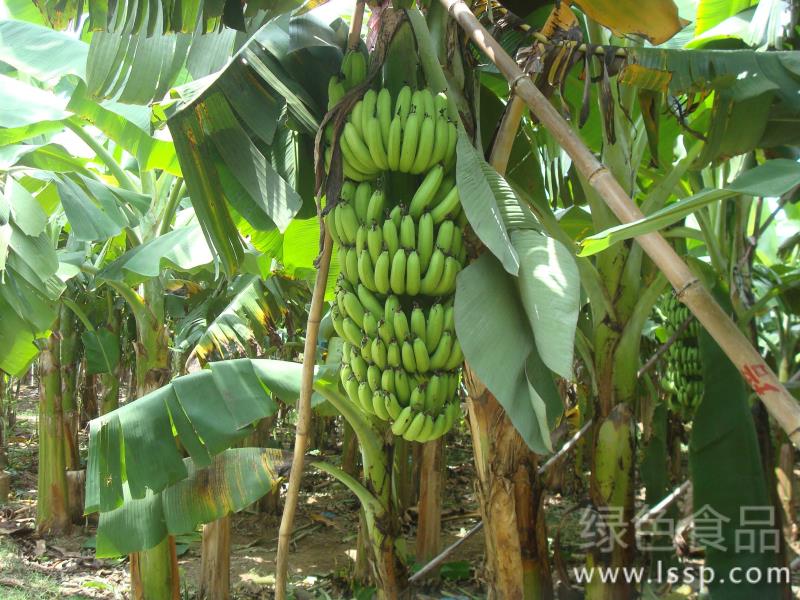
Banana
1. Fertilizer and water management at the seedling stage
Banana seedlings (especially tissue-cultured seedlings) need fertilizer but are sensitive to heavy fertilizer, and they need water but are sensitive to waterlogging. Therefore, keeping the soil moist and applying organic-matter-rich fertilizer frequently in small amounts are the basic principles of fertilizer and water management at the seedling stage.
① Rhizosphere topdressing: About 10 days after planting, bananas can be watered with liquid fertilizer: apply 1-2 kg of dilute manure water or 1-2 kg of 0.2%-0.3% organic compound fertilizer solution per plant (once every 10-15 days, for 3-5 consecutive applications); about 2 months after planting, apply 40-50 kg of ecological organic compound fertilizer per plant, or 0.3 kg of ternary compound fertilizer + 0.5 kg of (composted) bran fertilizer, applied in a furrow 30 cm away from the banana, and then apply again after 20 days.
② Foliar topdressing: Use 10 mL of Shengzhifeng liquid fertilizer or paste organic fertilizer diluted in 15 kg of water (add a little spreader or neutral laundry detergent to the prepared solution) and spray 3-5 times (at 7-day intervals) to ensure that banana seedlings grow early and quickly and thrive.
2. Fertilizer and water management at the mid stage
When bananas have 18-30 leaves, their fertilizer demand increases markedly, but applying too much chemical fertilizer at one time will damage the roots. Each banana plant should be given about 0.4 kg of ecological organic compound fertilizer, 0.2 kg of potassium chloride, or 0.4-0.5 kg of multi-element compound fertilizer, 0.1 kg of potassium chloride, and 0.5 kg of bran fertilizer every 20 days or so. When fertilizing, open a shallow circular furrow along the banana drip line, and water after application; the same applies below. If bananas with poor growth are found, immediately spray organic-matter-rich foliar fertilizer 1-3 times to promote growth. Water management principle: moist but not waterlogged.
3. Fertilizer and water management at the bud differentiation stage
At this stage (30-40 leaves), bananas have their greatest fertilizer demand. Every 20 days, apply 0.1-0.2 kg of urea, 0.2 kg of potassium chloride, and 0.5-1 kg of bran fertilizer (or 0.5 kg of ecological organic compound fertilizer + 0.1 kg of potassium chloride) per banana plant. Broadcast the fertilizer after rain or after irrigation, keep the soil moist, and water or irrigate promptly during drought.
4. Management after bunch emergence
The period from bunch emergence to harvest for spring-planted bananas happens to be the winter and spring seasons with relatively low temperatures, and at this time the banana roots are aging, so the absorption capacity of the banana root system is extremely poor. Therefore, one of the key measures for achieving high yields through fertilizer is to apply warm organic quick-acting fertilizer and organic foliar fertilizer. It is recommended that after bunch emergence, apply 0.1-0.2 kg of ecological organic compound fertilizer and 0.1 kg of potassium fertilizer per plant, for 2-3 consecutive applications (at 15-day intervals), and spray Shengzhifeng liquid or paste organic fertilizer or Shengduosu, etc., 3-5 times consecutively. During the bell-dropping stage, spraying the fingers with 2,4-D can elongate the fingers, but pay attention to the concentration and amount of the solution so as not to affect the fruit shape and quality of the banana.