Four Measures for Spring Fresh-Eating Corn to Lay the Foundation for Economic Returns
Spring fresh-eating corn can fill the gap in the corn market, and its economic returns should be quite good, but because growers' techniques cannot keep up, fresh-eating corn has not shown a very good trend. Today, the editors of Green Food Network have summarized the "Four Measures" for everyone to help improve the economic returns of fresh-eating corn.
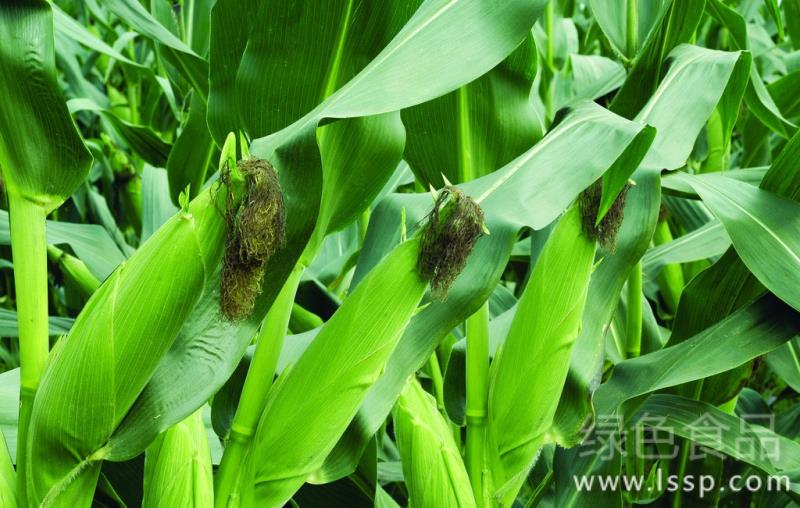
Corn
1. Pre-sowing preparation. Before sowing corn, apply sufficient base fertilizer and build up sufficient soil moisture. Apply about 4,000 kg of organic fertilizer and 5 kg of diammonium phosphate per mu. Plant in wide and narrow rows, with a wide row spacing of 0.6-0.8 m and a narrow row spacing of 0.4 m. Spray herbicide in the narrow rows 3-5 days before sowing corn, then cover with plastic film to kill weeds and raise soil temperature. For the corn seed, choose compact, high-quality corn varieties with a short growth cycle.
2. Sowing. Sow from late February to early March, that is, around Awakening of Insects. Make holes 3-5 cm deep in the narrow rows and sow, with about 18 cm between corn plants. Note that when sowing, the two rows of corn should be staggered so they alternate with each other. The sowing rate is 4-4.5 kg/mu, and cover with soil after sowing. Then cover the plastic film with a small arched shed about 30 to 40 cm high.
3. Field management. Thin seedlings early, about at the 3-leaf stage of corn. Pay attention to proper ventilation. When the corn touches the top of the arched shed, promptly break the film to let the seedlings out, so as not to burn the seedlings. In addition to fertilizing and watering during the key periods of corn, such as jointing, large trumpet stage and tasseling, management should also be flexible and watering should be done whenever drought occurs. When watering, an appropriate amount of fertilizer can be added to the water, with 10 kg of urea per mu of corn field being suitable.
4. Harvest. The corn harvest time can be controlled flexibly. If the market price is high and the corn can also be boiled for eating, it can be harvested. If the market price is not high, harvest after the corn is fully mature. After the early spring corn is harvested, another season of summer corn can be planted right after.