Asparagus often suffers from pests and diseases; how do you prevent and control the main three diseases and four insects?
Asparagus is a vegetable highly prone to pests and diseases, mainly the "three diseases and four insects." The so-called "three diseases" refer to brown spot disease, stem blight, and anthracnose; the so-called "four insects" refer to noctuid pests, aphids, thrips, and mole crickets. So how should these "three diseases and four insects" be prevented and controlled?
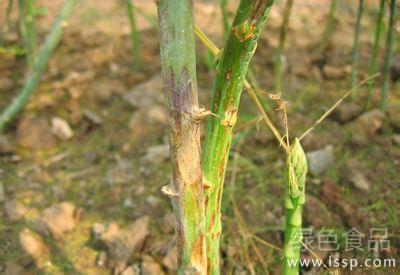
Brown spot disease of asparagus
Brown spot disease, one of the "three diseases"
This disease mainly harms the stems, branches, and cladodes of asparagus, but it mainly harms the small branches and cladodes. When the disease is severe, it often causes asparagus to dry up and die prematurely.
Control measures: Use 75% chlorothalonil and 50% carbendazim, dilute the above agents separately into 500-800 times solutions for spraying. When the disease is mild, spray once about every 10 days; during the peak period, spray once about every 7 days.
Stem blight of asparagus
Stem blight, one of the "three diseases"
This disease mainly occurs on the stems, lateral branches, or leaves of asparagus. The spindle-shaped or short linear lesions have a hydrophilic edge and appear water-soaked.
Control measures: Adhere to the principle of prevention first and integrated control. Select suitable planting land; thoroughly clean the field and promptly cut off diseased and dead plants; prune branches and remove side shoots at the right time; pay attention to drought resistance and drainage; fertilize reasonably; and manage the field well.
Chemical control: When the newly retained mother stems of asparagus grow to 15 cm, apply 50% carbendazim to the mother stems. After the mother stems branch, at intervals of 7-10 days, alternately use 32.5% Asparagus Green No. 2 600 times solution, 50% iprodione 1000-1500 times solution, and 0% thiophanate-methyl 700 times solution for one spray.
Anthracnose of asparagus
Anthracnose, one of the "three diseases"
It mainly harms stems, with gray to light brown lesions, spindle-shaped or irregular; later, small black spots grow on the diseased parts of asparagus.
Control method: At harvest, promptly gather diseased and remnant asparagus and bury them deeply or burn them; during the disease period, pay attention to drainage after rain in the planting land, strictly prevent flooding irrigation, and schedule asparagus watering in the morning to reduce nighttime dew formation; in the early stage of the disease, spray 70% mancozeb wettable powder 500 times solution, and 75% chlorothalonil wettable powder 600 times solution, once every 5-7 days, for 2-3 consecutive treatments, and stop the medicine 7 days before harvest.
Noctuid pests, one of the "four insects"
Control method: Black light lamps or sugar-vinegar liquid can be used to trap and kill adult noctuid pests; choose chemical control when the young larvae have not yet dispersed or hidden in the soil. After maturity, noctuid pests have very strong resistance to pesticides and are often difficult to kill. Generally, based on forecasting, spraying 4-5 days after the egg-laying peak gives the best effect. Spraying in the evening is better than during the day. The agents include: spraying 90% trichlorfon crystal 1000 times solution; 40% chlorpyrifos 1000 times solution can also be used for spraying; 5% chlorfluazuron 1000 times solution can also be selected for spraying.
Aphids and thrips, among the "four insects":
Control method: Keep the field clean, weed frequently, and irrigate promptly; for control, spray 25% fenvalerate-malathion mixture 2000 times solution; 50% dichlorvos 1000 times solution can also be used to spray asparagus; 10% imidacloprid 1000-1500 times solution spray.
Mole crickets, among the "four insects":
Use 90% trichlorfon 30 times solution with an appropriate amount of water and stir, mix until moist, apply 1.2-2.5 kg per mu; the best time to broadcast is on a windless, stuffy evening. Use 1 kg of 3% phoxim granules, mix with 3 kg of fine sand, and broadcast it in the asparagus seedbed.