What cultivation and management techniques are needed for blanching celery
Celery grown by conventional methods has a high fiber content, and often because management is not meticulous or harvesting is not timely, the stalks become rather hard, affecting their commercial value. If blanching cultivation methods are used for celery, it can not only reduce the fiber content of the celery stalks, improving eating quality and commercial value, but also increase yield, extend the harvest period, and achieve high quality, high yield and high returns. The blanching techniques for celery are briefly described below:
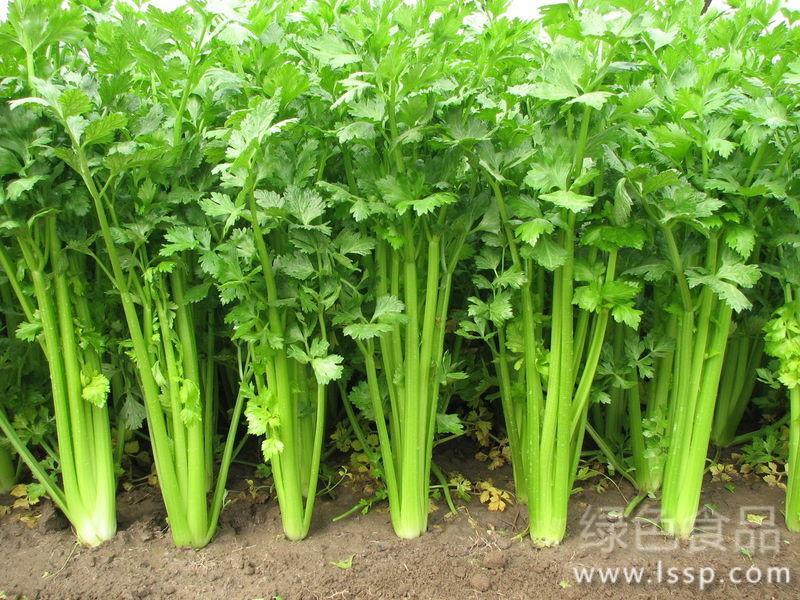
Celery
1. Blanching by mounding soil.Celery row spacing is 33-40 cm. In October-November, when the seedlings are 35-50 cm tall, apply sufficient topdressing fertilizer and water thoroughly according to the actual condition of the celery. After 5-7 days, tie up the base of each celery plant with rice straw or nylon rope, then loosen the soil so that it dries slightly, then cover about 3.3 cm of soil on both sides of the celery, and pat the mounded soil lightly firm so that the soil surface is smooth. After 2-3 days, mound soil again, and repeat this 5-6 times in succession until the total mounded height is between 20-25 cm. During mounding, take care to leave the heart leaves of the plants exposed and not to damage the young shoots. It is best to mound soil in the afternoon on a sunny day when the soil is not wet. After about 40 days, the celery can be harvested for eating or sold.
2. Blanching by enclosing with boards.The row spacing and seedling height are the same as above. First prop up the plants so that they stand upright and upward, exposing the soil between the rows, then use wooden boards about 2-3 m long, 15-12 cm wide and 2-3 cm thick, placed along the rows on both sides of the celery plants, and fix both ends of the boards with wooden stakes. Between the two boards, cover with soil 15-17 cm thick, taking care not to let soil fall into the heart of the celery, so as to avoid the plants rotting. After about 30 days, it can be harvested for eating or sold.
3. Blanching by clamping with bamboo.The row and plant spacing and seedling height are the same as above. Clamp the celery stalks along the planting rows with slender bamboo poles or bamboo strips, exposing the space between rows, tie the two ends and the middle of the bamboo poles with straw rope or nylon rope, then mound soil in stages according to the soil-mounding blanching method. After 30 days, it can be harvested for eating or marketed.
4. Natural blanching,also called close-planting semi-shade blanching. For autumn-sown celery, plant in clumps at a plant and row spacing of 7×7 cm, with about 3-4 seedlings per clump. Cover around the edges of the bed with soil 20-28 cm thick, and surround the celery with straw curtains woven from rice straw, reeds, thatch, etc. Before the celery closes its rows, cultivate 2-3 times to promote tillering. The leaves grow luxuriantly; cover the top to close the rows as early as possible, so that the celery stalks grow in a dark environment and achieve the purpose of blanching.