Control methods for six common tomato diseases
Tomatoes often suffer from several diseases, such as fruit cracking, early blight, late blight and so on. Today, the editors of Green Food Network introduce to vegetable growers the symptoms and control methods of six common tomato diseases.
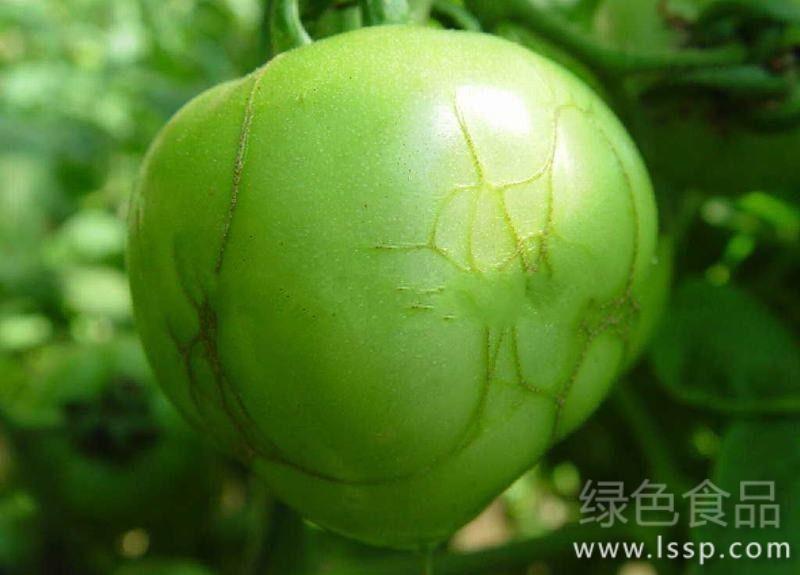
Cracked-fruit tomato
Tomato fruit cracking.From the swelling stage to the green-ripe stage, the tomato skin begins to crack mostly in a radial pattern, first as small cracks, and before coloring the cracks deepen. Some also crack in a ring shape centered on the tomato stem end. Water imbalance is the main cause of tomato fruit cracking, and the variety also has a considerable influence. Measures to prevent tomato fruit cracking: First, choose tomato varieties that are resistant to cracking, have lush branches and leaves, and have thicker and tougher skin. Second, keep the planting soil at suitable dryness and moisture. Third, apply more organic fertilizer, improve the soil structure, and enhance the water- and fertilizer-holding capacity of the planting soil. Fourth, moderately prune and pinch out the growing tips of the tomato, ensuring lush branches and leaves so that excess water can be transpired away, and preventing the tomato from being exposed to direct strong light. Fifth, harvest in time.
Early blight tomato
Tomato early blight.After the disease occurs, concentric ring-patterned lesions appear on the tomato leaves, dark brown, water-soaked; after the stem, petiole and fruit are affected, concentric ring-patterned lesions also appear, and when air humidity is relatively high, black mold-like substances appear on the lesions. Before and after the disease occurs, a dilution of 70% mancozeb wettable powder that needs to be diluted 500 times, or a dilution of 75% chlorothalonil wettable powder that needs to be diluted 400 times, can be sprayed on the tomatoes, once every 7 days, for 3-4 consecutive sprays.
Leaf mold tomato
Tomato leaf mold.Around the stem end of the affected tomato there are sunken and relatively hard black lesions, the tomato leaves have irregular yellow lesions, and when humidity is relatively high, brown mold layers are produced, causing the leaves to turn yellow, curl, and then fall off. After the disease occurs, a dilution of 70% mancozeb wettable powder that needs to be diluted 500 times, or an 800-1000 times dilution of 50% procymidone wettable powder, can be sprayed on the tomatoes, once every 7 days, for 3-4 consecutive sprays.
Gray mold tomato
Tomato gray mold.Usually green tomatoes are affected more severely. Gray mold first infects the remaining stigma or petals, then spreads to the tomato or fruit stalk, causing the tomato skin color to turn grayish white, accompanied by a thick gray water-rot-like mold layer. During the flowering period, a 0.1% concentration of 50% procymidone wettable powder, or a dilution of 50% virus A wettable powder already diluted 500 times, or a dilution of virus spirit diluted 800 times, can be added to the flower-dipping agent solution and sprayed on the tomatoes, once every 7 days, for 2-3 consecutive sprays.
Late blight tomato
Tomato late blight.The petioles and main stems of the tomato become dark brown and show rotting, the seedlings wilt and fall over, the lesion starts at the leaf tips and leaf margins, white mold-like substances appear when humidity is relatively high, and when dry they wither; the brown lesions turn dark brown, water-soaked or cloud-patterned, slightly sunken, and the diseased fruit is hard. When the disease occurs, a dilution of 40% phosethyl-Al wettable powder that needs to be diluted 300-400 times can be sprayed on the tomatoes, once every 7 days. Late blight can also be controlled by the dust method, that is, using a duster to apply 1 kg of 5% chlorothalonil compound powder per mu each time, sprayed in the evening.
Blossom-end rot tomato
Tomato blossom-end rot.Water-soaked lesions appear at the blossom end of the tomato, then gradually expand, causing the top of the tomato to become sunken and brown; the lesions are usually 1--2 cm in diameter, and in severe cases extend to half of the tomato. When dry, the diseased part is leathery, and under moist conditions, various white, pink and black mold layers grow on the surface. When the disease occurs, 0.1% calcium nitrate, British calcium or 1% superphosphate, etc. can be applied as a foliar top dressing, once every 10 days, for 2-3 consecutive sprays.