How to carry out field management of "kidney-tonifying grass" okra
As a rare and special vegetable variety, okra contains a slimy juice composed of substances such as galactan, pectin and araban. It has a smooth mouthfeel and the effects of aiding digestion, enhancing human endurance, protecting the liver and whitening the skin, so okra has good market prospects. Okra is planted from late April to early May. When the plant has unfolded 3-4 true leaves and the seedling age is 30-40 days, it is planted. At planting, the plant spacing is 60 cm and the row spacing is 50 cm, which facilitates later harvesting. The following briefly introduces the field management techniques for okra after planting:
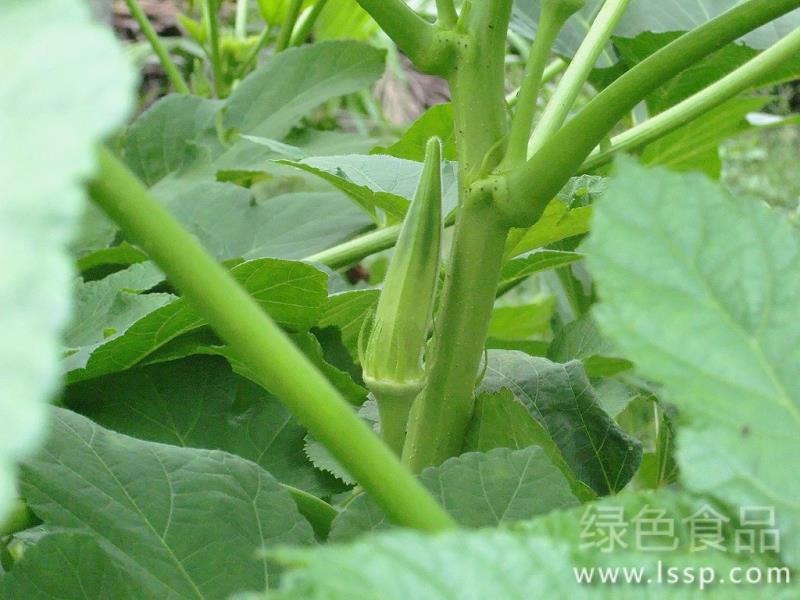
Okra
1. Thinning seedlings and breaking the heart.That is, carry out the first thinning of okra and remove the remaining weak seedlings. At 2-3 true leaves, thin the second time, selecting and keeping strong seedlings. At 3-4 true leaves, final thinning is carried out, leaving 1 plant per hole.
2. Intertillage, weeding and earthing up
After okra seedlings emerge or are planted, the temperature is relatively low, so intertillage should be carried out 2 times in succession to raise the ground temperature and promote seedling recovery. Before the first flower of okra opens, intertillage should be strengthened so as to properly restrain seedling growth and favor root development. After flowering and fruiting, the plant grows faster. After each watering and topdressing, the soil should be turned. Before the rows close, intertill and earth up to prevent the plants from lodging. In areas with frequent rainstorms and wind in summer, it is best to insert bamboo poles or branches about 1 m long near the plants to prevent lodging.
Okra
3. Watering and fertilizing
① Watering. During the growth period, okra has relatively high requirements for air and soil humidity. If there is a lack of water within 20 days after sowing, choose the morning and evening periods for artificial sprinkler irrigation. After the seedlings are slightly larger, if there is a lack of water, mechanical sprinkler irrigation or furrow irrigation can be used. The peak harvest period of okra coincides with the hot summer season, when water demand is high and the surface temperature is high. Watering should be done before 9 a.m. or after sunset in the afternoon, so as to avoid damaging the roots by watering under high temperatures. During the rainy season, pay attention to drainage to prevent seedling death. Throughout the growing period, suitable soil moisture should be maintained.
② Topdressing. On the basis of applying sufficient base fertilizer to okra, topdressing should be done appropriately, and nitrogen fertilizer should not be applied alone. The first is the full-stand fertilizer, applied after emergence, with 90-120 kg of urea per hectare.
The second is the seedling-promoting fertilizer. After final thinning or planting, open a furrow and broadcast it, applying 225-300 kg of compound fertilizer per hectare. During the flowering and fruiting period, okra should be given one heavy application of fertilizer, with 30,000-45,000 kg of diluted human manure, or 300-450 kg of nitrogen-phosphorus-potassium compound fertilizer. In the middle and late growth stages, according to the situation, apply topdressing many times in small amounts to prevent premature senescence of the plants.
4. Plant adjustment.Under normal conditions, okra grows vigorously, with thick main and side branches and large leaves, which often delays the time of flowering and fruiting. The branch-twisting method can be adopted, that is, twisting the petioles of okra into a curved and drooping shape to control vegetative growth. In the middle and late growth stages, promptly remove the old leaves from each node of the tender okra that has already been harvested. This can not only improve the ventilation and light transmission conditions of the plants and reduce nutrient consumption, but also prevent the spread of pests and diseases. Plants harvested for tender okra should be pinched in a timely manner, which can promote fruiting on side branches and increase early yield. Plants harvested for okra seed fruits should be pinched in a timely manner, which can promote the aging and ripening of the seed fruits, favor full grains and improve seed quality.