What are the precautions for planting eggplants in spring? A must-read for farmers
As spring arrives, it is once again the season for farmers to start planting eggplants. So what precautions should be taken when planting eggplants in spring? The editors of Green Food Network would like to introduce them to you below.
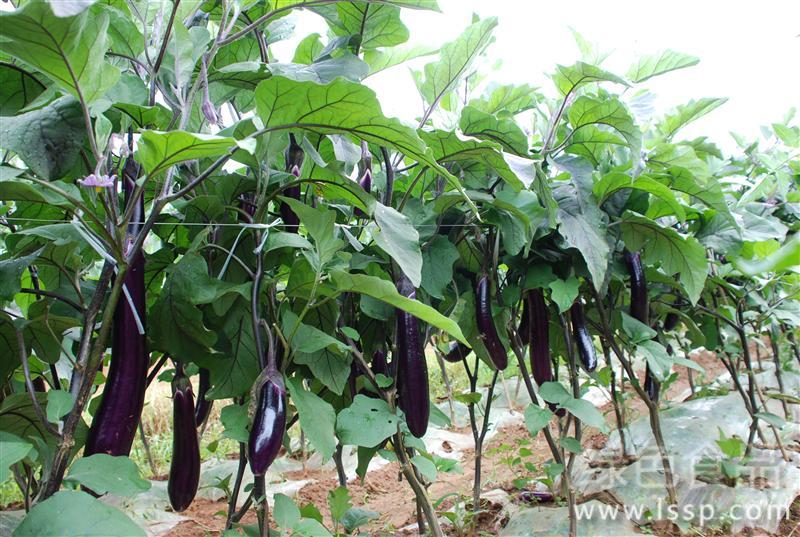
Eggplant
Eggplants like fertilizer and should not be grown in continuous cropping. Apply sufficient base fertilizer; per mu of field, 6000-7000 kg of decomposed manure and stable litter, 40 kg of phosphate fertilizer, and 100 kg of plant ash can be applied, then plow and level the land to make beds. Open furrows at a row spacing of 55 cm in a north-south orientation, with a furrow depth of 6 cm, and a plant spacing of 38-40 cm for eggplants. First place the eggplant seedlings, cover with soil, then water, and the next day form the ridges. Some also use wide and narrow rows, with wide rows at 60 cm and narrow rows at 50 cm. After ridging, cover the narrow row spacing with plastic film, and 2600-2700 eggplant seedlings can be planted per mu. At night, use small arched sheds to keep warm; maintain the daytime temperature between 25°C and 30°C, and the nighttime temperature between 15°C and 20°C, with appropriate ventilation at noon. After April, the ventilation of the arched sheds can be gradually increased according to weather conditions, but the nighttime temperature must not be lower than 15°C, otherwise eggplants that are flowering and fruiting will drop their flowers. Until the temperature of the external environment exceeds 15°C in mid-to-late May, ventilation can be carried out day and night.
During low-temperature periods, frequently clean the plastic film covering the eggplants so that the eggplant seedlings can absorb as much light as possible. It is best to hang an aluminized reflective screen on the north side of the greenhouse, which is very effective for increasing light and raising temperature. Moisture should be properly controlled. Apart from watering once on a sunny day within 3-4 days after eggplant planting to help the seedlings recover, generally no watering is done. When the eggplants grow to the size of walnuts, begin dark irrigation under the film. When the soil temperature reaches above 18°C in mid-to-late March, both dark furrow irrigation and open water irrigation can be carried out together, and attention should be paid to ventilation and air exchange. After the weather warms up, water the eggplants once every 5-6 days to keep the soil moist. After starting watering, topdress the eggplants once every half month, applying 20 kg of ammonium nitrate per mu each time.
To improve the ventilation and light transmission conditions of solar greenhouse cultivation, double-stem pruning can be carried out. After a pair of eggplants has formed, cut off the two outward-facing side branches, thus forming double stems in two directions. After that, all side branches on the eggplant plant should be removed. Generally, after 7 eggplants have set, pinch off the growing tip of the plant.