Broad bean pest and disease control measures must be done well for yields to be guaranteed
When growing broad beans in the field, pests and diseases are unavoidable, but how can the damage from broad bean pests and diseases be reduced to a minimum? That requires doing a good job of broad bean pest and disease control:
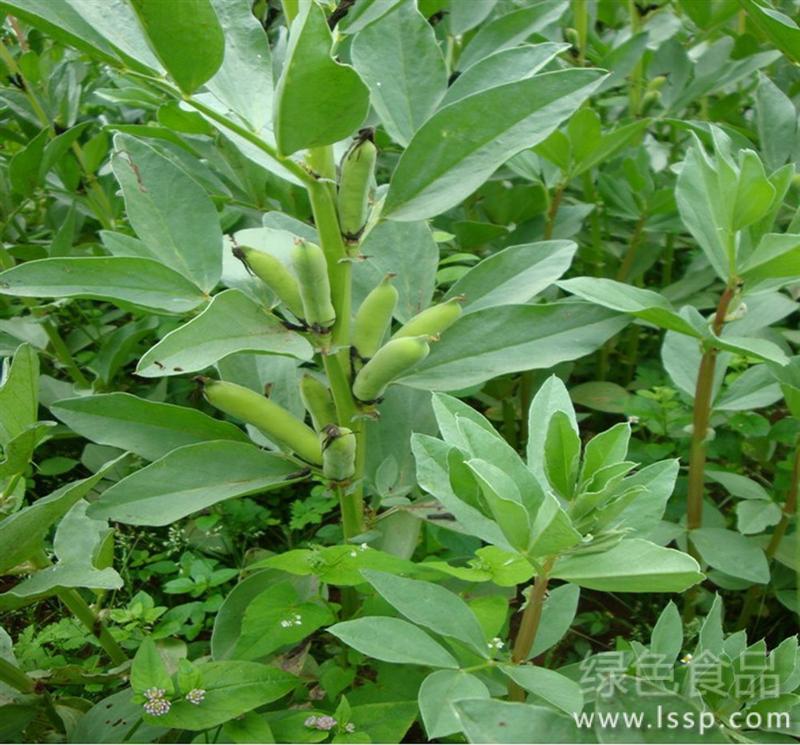
Broad bean
I. Agricultural control
Select new disease-resistant broad bean varieties, implement a rotation of more than three years with non-legume crops, adopt intercropping and relay intercropping of broad beans and isolated-strip protective cultivation of broad beans, and adopt plant cultivation control techniques; coordinate the distribution of light, heat, water and air among broad bean plants; promptly pull out diseased plants, remove diseased leaves and diseased pods, and manually clean the garden thoroughly.
II. Physical control
1. Facility protection: use insect-proof nets to seal the ventilation openings of large facilities, and use plastic film, insect-proof nets and shade nets for rain-sheltered, shaded and insect-proof cultivation to reduce the occurrence of broad bean pests and diseases.
2. Trapping and repelling: for broad beans grown under protected cultivation, yellow boards can be used to trap and kill aphids and leafminers, hanging 30 to 40 yellow boards of 25cm×40cm per 667m2. For broad beans grown in the open field, spread silver-gray plastic film or hang silver-gray film strips to repel aphids; set up one frequency-vibration insect-killing lamp per 2hm2 to 4hm2 to trap and kill pests.
III. Biological control
Natural enemies: actively protect and utilize the natural enemies of pests such as aphids and leafminers to control broad bean pests and diseases.
Broad bean
IV. Biological agents
Use biological pesticides such as azadirachtin, pyrethrin, Nongkang 120, matrine, and Bacillus thuringiensis.
V. Chemical control
Chocolate spot, rust and aphids are the main pests and diseases of broad beans, and high-efficiency, low-toxicity, low-residue pesticides can be selected for control. In recent years, the damage to broad beans from leafminers has worsened, and a 1000-fold dilution of 50% phoxim can be sprayed for control.
Pesticides: shall comply with the requirements of GB 4285 and GB/T 8321 (all parts). Pay attention to rotating pesticides, mixing them reasonably, and strictly controlling the pre-harvest interval. Highly toxic, high-residue pesticides prohibited for disease and pest control: for growing broad beans, it is not permitted to use highly toxic, high-residue pesticides such as methamidophos, methyl parathion, parathion, monocrotophos, phosphamidon, phorate, isofenphos-methyl, terbufos, mephosfolan, phosfolan, demeton, carbofuran, aldicarb, ethoprophos, phosfolan, coumaphos, phorate, chlorpyrifos, and fenamiphos.