Analysis of the Causes of Fruit Abortion in Greenhouse Zucchini and Its Control Methods
Zucchini fruit abortion refers to the phenomenon in which, within 3-4 days after the female flower of zucchini opens, the front part of the young fruit turns from green to yellow, becomes thinner and softer, the fruit swells very little or not at all, the surface loses its luster, the tip shrivels, and finally the fruit rots or drops off. At present, fruit abortion has become a "roadblock" in zucchini cultivation. The causes and preventive measures of zucchini fruit abortion are now introduced to vegetable growers.
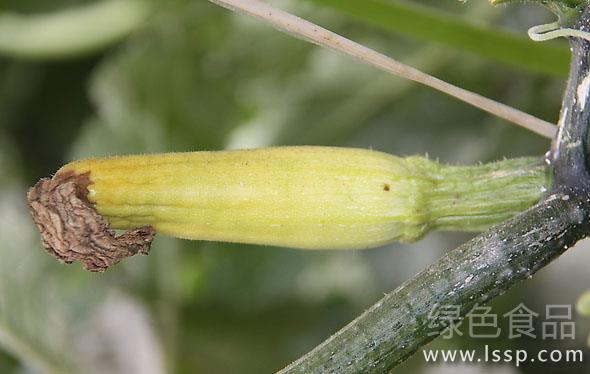
Zucchini fruit abortion
I. Causes of fruit abortion
Zucchini fruit abortion is mainly caused by unsuitable environmental conditions or imbalanced nutrient supply.
1. Temperature.If the temperature is too high, exceeding 35°C during the day and above 20°C at night, zucchini photosynthesis decreases and respiration increases, a large amount of carbohydrates is transported to the stems and leaves, the vines grow excessively, and fruit abortion occurs due to malnutrition. If the temperature is too low, below 20°C during the day and below 10°C at night, the absorption capacity of the zucchini root system weakens, photosynthesis also decreases, and fruit abortion eventually occurs due to nutritional starvation.
2. Light.If zucchini at the flowering stage encounters continuous overcast days or continuous rainy weather, the day-night temperature difference is small, zucchini photosynthesis is affected, nutrient production is less than consumption, and fruit abortion eventually occurs due to malnutrition.
3. Planting density.Density is also one of the factors affecting zucchini fruit abortion. When density is high, zucchini roots compete for nutrients in the soil, while the aboveground stems and leaves compete for space to spread. When the leaf area index is higher than 4, light transmission and air permeability decrease, photosynthetic efficiency is not high, consumption increases, and the fruit abortion rate rises.
4. Pollination.Because zucchini pollination is poor or pollination does not occur at all, plant auxin cannot be produced in the ovary, causing the embryo and endosperm of zucchini to fail to grow normally. In addition, when the nutrient supply to the female flower is insufficient, the auxin content in the ovary also decreases, so the fruit cannot set and abortion occurs.
II. Preventive measures
1. Regulate temperature.Keep it at 25-30°C during the day; if it exceeds 30°C, ventilation should be carried out appropriately. Keep it at 15-20°C at night; if the temperature is too low, heating can be provided through a stove.
2. Supplement light.Remove the straw mats early in the morning and put them down late to maintain the temperature inside the shed. If continuous overcast days or continuous rainy weather occurs, reflective film or lighting lamps can be attached or hung to enhance light.
3. Determine suitable density.Planting density should be controlled at 2000-2500 plants per mu. When planting zucchini with wide and narrow row spacing, the wide row spacing is 80 cm, the narrow row spacing is 60 cm, and the plant spacing is 40 cm.
4. Hormone treatment.2-3 days after the zucchini female flower opens, spraying with 100 mg/kg gibberellin or 100 mg/kg p-chlorophenoxyacetic acid can both make zucchini grow quickly and make fruit abortion less likely.