Wheat flowering season is approaching, how to prevent and control fusarium head blight
At present, for wheat about to enter the heading and flowering stage, the most critical task is to prevent and control wheat fusarium head blight. Wheat fusarium head blight not only affects yield but also causes wheat grains to rot and deteriorate. The toxins secreted by the fusarium head blight pathogen can also poison humans and livestock. In ordinary years, wheat yield can be reduced by 10-20%, and in epidemic years, wheat yield can be reduced by 50-60%, or even total crop failure.
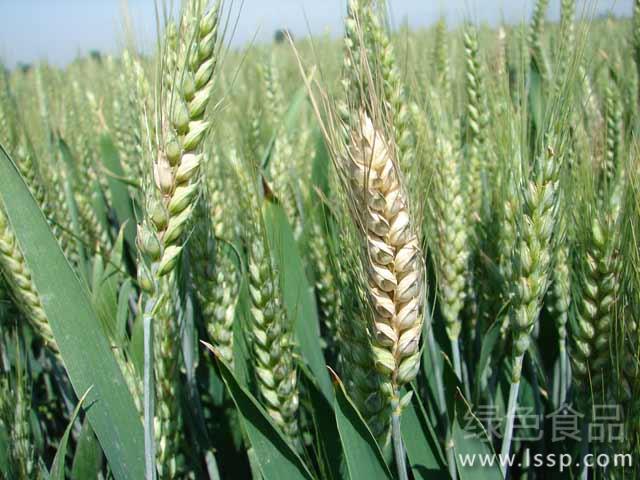
Wheat fusarium head blight
Fusarium head blight mainly damages the ear of wheat. Infection during the seedling stage causes seedling rot, while infection in the middle and late stages causes wheat stalk rot and ear rot, among which ear rot is the most harmful. Generally, infection occurs at the flowering stage, symptoms appear at the grain-filling stage, and disaster occurs at the maturity stage. In the early stage of fusarium head blight infection, water-soaked brown spots appear on the spikelets and glumes, then the entire spikelet becomes infected, and the diseased spikelets quickly turn yellow and wither. In the late stage of the disease, a pink gelatinous mold layer appears at the base of the wheat ear.
Wheat fusarium head blight is caused by infection by multiple species of Fusarium. The fusarium head blight pathogen overwinters and oversummers as mycelium on the residues of crops such as wheat or corn stalks, and in the spring of the following year forms ascospores, which spread to the wheat ear through airflow and invade the spikelets from the withered anther parts of the wheat. The ease of pathogen invasion varies greatly at different growth stages of wheat, with the flowering stage being the most susceptible, followed by the heading stage. Under conditions where a large amount of fusarium head blight inoculum exists, if wheat during the heading and flowering stage encounters more than 3 consecutive days of overcast and rainy weather with temperatures remaining at 15°C or above, fusarium head blight will become epidemic.
The key to preventing and controlling wheat fusarium head blight is to carry out pesticide spraying prevention during the heading and flowering stage. First, grasp the timing for controlling fusarium head blight well. If continuous overcast and rainy weather is encountered during the heading stage, the timing of preventive spraying should be earlier rather than later. When 10% of the wheat per mu is at the initial stage from heading to flowering, spray for the first time, and apply the second treatment at an interval of 5-7 days. Second, select suitable control agents. Use 100 grams per mu of 50% carbendazim wettable powder, or 50-75 grams of 70% thiophanate-methyl wettable powder mixed with 50 kg of water, or 50 grams of diniconazole (Heguoli) solution mixed with 30 kg of water to spray wheat. Third, master the application method well. During spraying, focus on spraying evenly toward the wheat ear. If rain occurs after spraying, supplemental spraying is needed after the rain.