Good apple tree bloom-period management boosts both apple yield and quality
Managing apple trees scientifically and carefully during the bloom period can effectively increase the yield and quality of that year's apples and raise farmers' income. So how should apple tree bloom-period management be done well?
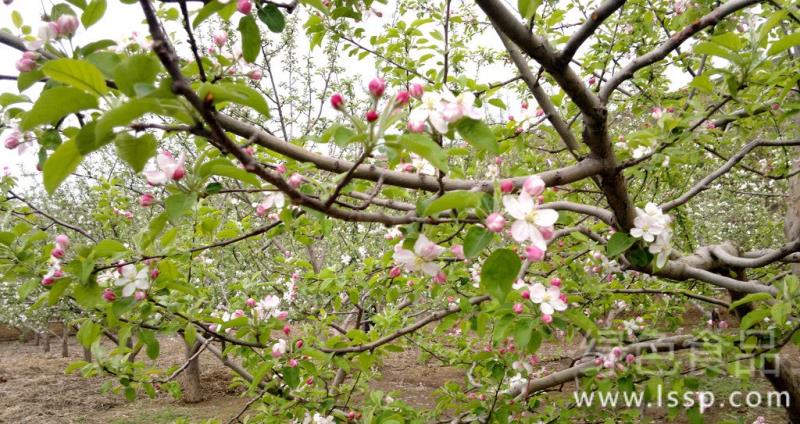
Apple trees in bloom
I. Scientific flower and fruit thinning
Flower thinning and fruit thinning are effective measures for overcoming alternate bearing in apples and improving apple quality; thinning flower buds works better than thinning flowers, and thinning flowers is better than thinning fruit. Fruit thinning generally starts 1 week after the apple trees finish blooming. Vigorous apple trees with a strong bearing capacity should be thinned less, and vice versa. The amount of fruit to thin can be determined by the following two methods: first, spaced flower thinning, in which, depending on how many flowers there are, you leave one and remove one or leave several and remove one; second, fruit thinning by distance, generally leaving 1 apple every 15-25 cm. When thinning fruit, note that the fruit set from the center flower should be kept, and the fruit set on the side flowers should be thinned away. Diseased and insect-damaged fruit, misshapen fruit and short-branch fruit on the upper side of the main and lateral branches should all be thinned away, while hanging fruit, fruit with a regular shape and oblong fruit should be kept. Generally speaking, the number of fruit to leave per apple tree should be determined according to the yield standard and based on tree age, tree vigor and other conditions.
II. Artificial supplementary pollination
Artificial supplementary pollination is an important measure for overcoming the effects of abnormal weather during the apple tree bloom period, making up for an insufficient number of pollinating apple trees or improper arrangement, and raising the apple fruit-setting rate. Apple varieties with a similar bloom period, sufficient pollen and basically consistent cultivation management should be chosen. When pollinating, put the pollen in a glass bottle and use the rubber end of a pencil to dip the apple pollen and dot-pollinate it onto apple flowers that have just opened that day, with the center flower being the best choice.
III. Placing bees during the bloom period
Bee pollination can save labor and also noticeably raise the apple fruit-setting rate. Bees are accustomed to gathering nectar nearby, with a nectar-gathering radius of about 200 m; therefore, set up 1 bee group per mu of apple orchard, with 4-6 bee hives placed per group.
Apple trees in bloom
IV. Foliar topdressing to raise the nutrient level of the apple trees
Spray 2-3 times with Plant Baotailing (one bag per 30 jin of water) solution before and after flowering, spray 0.3%-0.5% Zuoguowang solution and Shenqi Plant Baotailing solution once at the early full-bloom stage, and spray 400-fold Weiltai solution once after flowering. In addition, 5 days after blooming ends, ring-barking can be done on the auxiliary nurturing branches of the apple trees to concentrate nutrients for apple growth.
V. Pest and disease control
Before flowering, spray 30% Taoxiaoling 700-1000-fold solution to control pests such as the golden leaf miner moth and scarab beetles; after blooming ends, spray Baohusan Yebanjing 1200-fold + 80% carbendazim 800-fold solution to control early defoliation disease, ring rot and anthracnose, etc. Apple trees 7-10 days after blooming ends need spraying with avermectin, 70% Zhufei pymetrozine and Taoxiaoling to control spider mites and aphids. To control bitter pit, spray Weiltai 400-fold solution.