Cultivation techniques for high-mountain snow peas can fill the market supply gap during the off-season
Snow peas are normally sown in winter and harvested in spring, so after June there is very little snow pea supply on the market. Growing snow peas using the cool summer climate of high mountains can fill the off-season gap in snow pea supply. However, off-season cultivation of snow peas differs from normal-season cultivation, and vegetable growers should pay attention to the following three aspects.
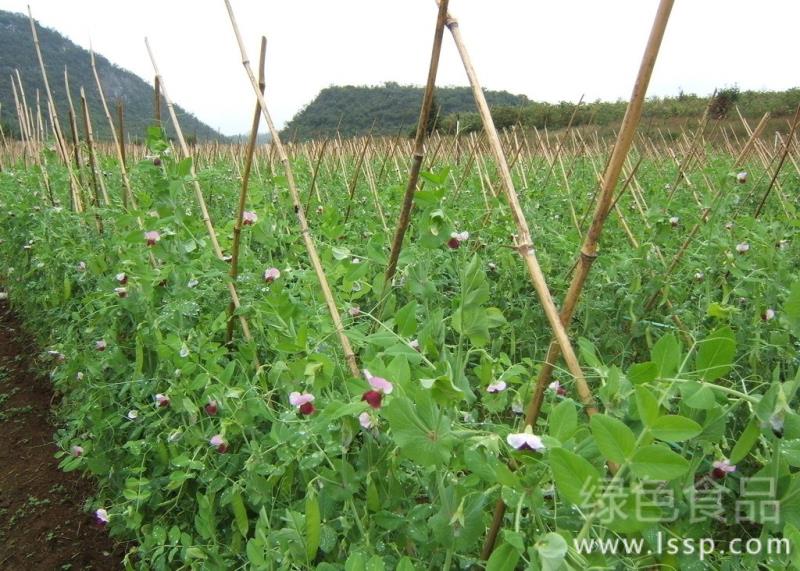
Snow peas
Choose a suitable altitude.As a low-temperature crop, snow peas cannot tolerate high temperatures. In high-temperature environments, snow peas suffer severe disease, with low yield and poor quality. High-mountain snow peas must also be planted in places that are not hot in midsummer. According to the rule that the temperature drops by 0.6°C for every 100 m increase in altitude, choose a high-mountain area for planting, generally at an altitude of 600-800 m.
Choose suitable varieties.For semi-vining snow pea varieties, Japanese Xiahama pea and Otome No. 2 can be used; for vining snow pea varieties, Taichung No. 11 and Japanese Matsushima No. 30 can be used. These varieties are disease-resistant, have strong branching ability, and are heat-tolerant.
Choose a suitable sowing period for snow peas.There is more rain in spring and summer, which affects flowering and pod setting in snow peas, so the flowering period of snow peas should be arranged after the rainy season ends. Therefore, the sowing period for snow peas is best chosen from mid-May to early June. In mountain areas at an altitude of 600-800 m, sow in late May; in mountain areas above 900 m, sow in mid-May.
Choose a suitable cultivation method for snow peas.Before sowing, plow the soil and apply 1000-1500 kg of organic fertilizer per mu, then prepare the land and make beds 40 cm high and 100 cm wide. Open a small furrow in the middle of the bed, and at a plant spacing of 10 cm, sow 2-3 snow pea seeds per hole, in single-row planting.
Reasonable topdressing: at the seedling stage of snow peas, decomposed organic fertilizer can be applied; at the bud stage, 1-2 applications of quick-acting nitrogen fertilizer can be given as topdressing; after every 2 harvests, spray a mixed solution of monopotassium phosphate and urea once. Spraying boron fertilizer and molybdenum fertilizer at the appropriate time, and spraying Greenfenwei No. 1 or Penxibao once every 8-10 days, helps increase snow pea yield; for vining varieties, when the snow pea seedlings grow to about 20 cm, be careful to insert stakes and set up trellises in time; pest and disease control. Before sowing, seeds can be dressed with carbendazim plus jinggangmycin to prevent snow pea root rot; when trellising snow peas, apply pesticide by spraying every 5-6 days to control brown spot and powdery mildew. After budding and flowering, pay attention to the control of leafminers, pod borers, and aphids.