Greenhouse bell peppers prefer warmth and dislike humidity: key points of pollution-free cultivation techniques
Bell peppers are deeply favored for their bright colors, large fruits, thick flesh and rich nutrition, and their cultivation returns are considerable. Bell peppers have high requirements for temperature and water, prefer warmth and dislike humidity, and are not suitable for open-field cultivation. The key points of bell pepper cultivation techniques are as follows:
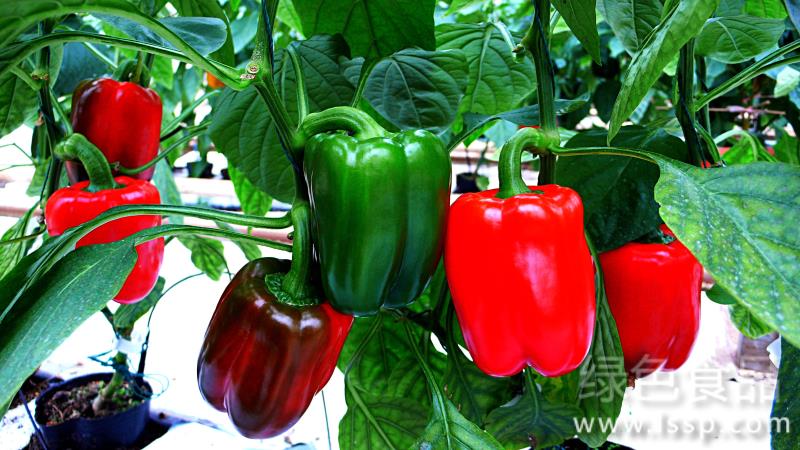
Bell pepper
I. Seedling raising
1. Variety selection. Choose bell pepper varieties with regular fruit shape, thick flesh, large fruits, bright color, disease resistance, tolerance to low light, and tolerance to low or high temperatures.
2. Seed treatment. If the purchased seeds are imported coated seeds, they can be sown directly; otherwise they must be treated to ensure uniform emergence and freedom from pathogens. Generally, bell pepper seeds are soaked in a 0.1% potassium permanganate solution for 30 minutes, with stirring during this period, then rinsed with clean water 3-4 times, after which the seeds are soaked in water at 55°C-60°C with constant stirring; when the water temperature drops to 30°C, let them stand for about 3 hours, then rinse with clean water 2-3 times, wrap the bell pepper seeds in sterilized wet gauze and place them in a constant-temperature chamber at 25°C-30°C for sprouting; when about half of the bell pepper seeds have sprouted, they can be sown.
3. Use plug-tray seedling raising. Fill the plug trays with prepared nutrient soil or peat soil, water thoroughly, and sow after the water has infiltrated. Sow one bell pepper seed per cell, with the radicle pointing downward when sowing, cover with about 1cm of soil after sowing, then spray water to soak thoroughly.
4. Seedling-stage management. To promote uniform emergence, keep 30°C-35°C during the day and 15°C-20°C at night. After emergence, lower the temperature appropriately to prevent bell pepper seedlings from growing leggy. Keep 25°C-28°C during the day and 14°C-17°C at night. Pay attention to watering; water once a day on sunny days. When the temperature is too high, appropriately take cooling measures such as using shade nets. To promote thick and strong growth of bell pepper seedlings, spray the bell peppers once with a 0.006% solution of 25% mepiquat chloride at the 3-4 true-leaf stage.
II. Transplanting
1. Preparation before transplanting. First apply base fertilizer in combination with plowing, applying about 1500-2000kg of decomposed farmyard manure, 40-50kg of diammonium phosphate, and 40-50kg of binary compound fertilizer per 667 sq m. Plow with manual labor or a rotary tiller so that soil and fertilizer are fully mixed. Then close the windows and doors of the greenhouse and carry out high-temperature sealed greenhouse treatment for 7-10 days to kill pests and diseases in the surface soil layer inside the greenhouse.
2. Making beds and transplanting. The bed surface width is 100-110cm, the bed ditch width is 60-70cm, and the bed ditch depth is 20-25cm. Plant double rows per bed, with a bell pepper transplanting row spacing of 75-80cm×45-50cm. The seedling age for transplanting is 4-5 true leaves.
Bell pepper
III. Management after transplanting
1. Temperature management. Keep 23°C-28°C during the day and 15°C-18°C at night; during the flowering and fruit-setting period of bell peppers, the maximum daytime temperature must not exceed 30°C, and the night temperature should be 17°C-18°C. Too low or too high a temperature will affect the flowering and fruiting of bell peppers.
2. Plant adjustment. Use hanging strings to train and fix the bell pepper plants. Below the first flower of the bell pepper, select and retain two vigorous branches as the main branches of the bell pepper plant; at the branching point of each main branch, keep one branch and one fruit, and remove all other branches, flowers and fruits as early as possible; take care to remove deformed fruits, and in the later growth period promptly remove yellow leaves, old leaves and diseased leaves from the lower part of the plant.
3. Fertilizer and water management. Before transplanting bell peppers, water sufficiently as bottom water or transplanting water, and do not water again during the seedling revival period. During the growth period, supply water according to soil moisture, pay attention to controlling the amount of watering, and use drip irrigation or light watering to ensure that the bell pepper plants are not short of water and grow and bear fruit normally. When sufficient base fertilizer is applied, topdressing is generally no longer needed; in the middle and late stages of growth, apply fertilizer in small amounts multiple times combined with watering, apply quick-acting potassium and nitrogen fertilizers and drench with a strong root-promoting agent, or spray a high-efficiency amino acid liquid fertilizer; after each 1-2 harvests of fruit, spray once with 0.1% potassium dihydrogen phosphate to ensure continued growth and fruiting of the bell pepper plants.
IV. Pest and disease control
1. Disease control. During the seedling stage, they are prone to damping-off and sudden wilting, etc.; the seedbed can be sprayed with an 800-1000 times dilution of 72% Previcur before sowing bell peppers; during the growth period, they are susceptible to leaf mold, root rot, phytophthora blight, etc., which can be controlled with a 500 times dilution of 50% thiophanate-methyl wettable powder, or a 600 times dilution of 75% chlorothalonil wettable powder, or a 500 times dilution of 64% oxadixyl plus mancozeb.
2. Insect pest control. Common pests of bell peppers include aphids, whiteflies, etc. During the seedling stage, a 1500 times dilution of 1.8% abamectin solution or a 1500 times dilution of 1.8% abamectin emulsifiable concentrate can be used; during the growth period, a 2500-3000 times dilution of 10% imidacloprid wettable powder, or a 1500 times dilution of 20% fenpropathrin solution, etc. can be used for control.