Key Management Techniques for Greenhouse Eggplant During the May High-Yield Period
May is the high-yield period for greenhouse eggplant, so management work must be done well and thoroughly. A moment of carelessness can cause a reduction in eggplant yield, so what management tasks are there for eggplant in May?
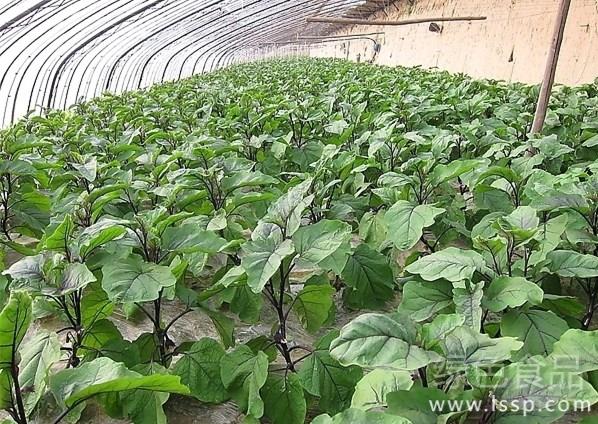
Greenhouse eggplant
I. Topdressing techniques
During the May high-yield period for eggplant, the demand for fertilizer and water is high. Eggplant likes water, so attention must be paid to maintaining sufficient moisture in the soil. If water is lacking, irrigation and furrow irrigation can be used. During irrigation, dissolve the fertilizers monoammonium phosphate, potassium sulfate, and ammonium bicarbonate in water at concentrations of about 0.3%, 0.15%, and 0.2% respectively. During furrow irrigation, fill one furrow with a large amount of water and evenly scatter the above fertilizers into the furrow water to dissolve. The amounts per mu can be 10 kg, 10 kg, and 15-30 kg respectively. If water is not lacking, then a hole can be dug in the middle of every four eggplant plants, and fully decomposed farmyard manure can be placed in the hole. Note: after topdressing, increase ventilation to prevent fertilizer damage and disease in eggplant.
II. Late-stage management: removing old leaves
In addition to removing axillary buds, except for keeping one or two of the lowest (largest) leaves on the eggplant plant, all other old leaves on the lower part of the eggplant should be removed.
III. Deeply dug furrows
Raising the bed surface with the soil dug from the furrows can prevent flooding, increase soil aeration, and lower soil temperature.
IV. Disease prevention
After May, the main diseases and insect pests of eggplant are gray blight, Phytophthora rot, and powdery mildew. Gray blight appears as light brown to brown lesions on mature eggplants, slightly sunken. When the disease worsens, the entire eggplant becomes dark brown. If humidity increases, a grayish-white frosty mold layer forms on the eggplant surface, gradually softening and rotting, giving off a foul odor. Gray blight can also develop during eggplant transport and on shop display stands. High temperature and high humidity favor the growth and development of Phytophthora rot pathogens and other pathogens. In summer, with high temperature and frequent rain, large numbers of eggplants rot and quickly grow white mold. Eggplants that are about to mature, after being infected by Phytophthora rot, quickly form rotten fruit.
Control methods:
The central diseased plants should be immediately pulled up and destroyed, and pesticide should be sprayed for control. Starting from the rainy season, use 1:1:200 Bordeaux mixture sprayed once every 7 days for protection, with very good results. Once disease occurs, pesticide must be applied immediately. The pesticides include 500-600 times 75% chlorothalonil liquid, 800 times 50% thiophanate-methyl wettable powder liquid, 200 times 40% fosetyl-aluminum wettable powder liquid, 500 times 64% oxadixyl-mancozeb liquid, etc. Generally, spray once every 7-10 days, for 3-4 consecutive sprays. Tianda-2116 special type for melons, eggplants, and fruits can be mixed with the above pesticides for use, with even better results. To prevent the development of pesticide resistance in eggplant, a different type of pesticide should be used each time.