Peanuts need water but also fear it; how do you correctly grasp the principles of water management?
The peanut is a crop that both needs water and fears it. A lack of water in peanuts affects yield, while too much water in peanuts leads to "water yellowing disease" and makes the roots prone to rotting. Therefore, doing a good job of peanut water management is extremely important.
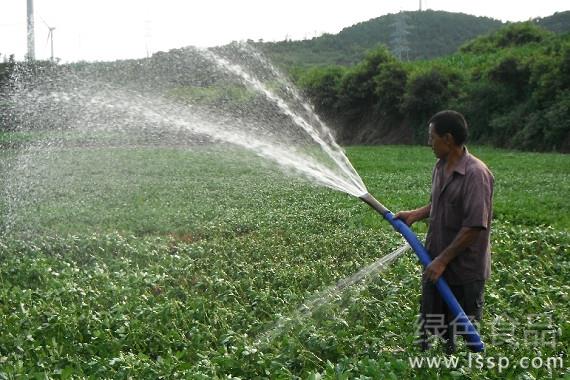
Peanut
1. The water requirements of peanuts can be summarized as follows:
1. It both needs water and fears water
According to measurements, for every 1 gram of dry matter a peanut synthesizes, it consumes 450-500 grams of water. For northern common-type peanuts with a yield of 250 kg per mu, the water consumption over the entire growing period is 290 cubic meters; for southern pearl bean-type peanuts with a yield of 200 kg per mu, the water consumption is 120-170 cubic meters. However, too much water, especially standing water in the field, is harmful to peanuts, causing the "water yellowing" phenomenon, inducing excessive vegetative growth and lodging, root rot and death, and rotten pods or sprouting.
2. Little at both ends and much in the middle, that is, water requirements differ at different growth stages: little at the seedling stage, much from flowering to pod-setting stage, and little at the full-pod maturity stage.
The full flowering stage of peanuts is the critical period for water requirement, and the pod-setting stage is the period of greatest water requirement. That is, the full flowering stage is the period when peanuts are most sensitive to water in their entire life; once water is lacking, yield is affected. The pod-setting stage has the greatest water requirement, and if drought occurs due to lack of water, the peanut yield loss will be very large. Therefore, during these two growth stages of peanuts, water supply must be ensured and water shortage must not occur.
2. The harm of excessive water to peanuts
Peanuts both need water and fear water. According to experiments, if peanut seedlings are flooded for 3-5 days, they will develop "water yellowing." When there is too much water at sowing, peanut seeds are forced to carry out anaerobic respiration to maintain life activities, producing and accumulating large amounts of alcohol and organic acids, causing poisoning and death of cells within the peanut seeds, resulting in rotten seeds and missing plants. Too much water at the peanut maturity stage easily causes rotten pods, rotten pegs, or seed sprouting, directly causing yield loss. Excessive vegetative growth, lodging, delayed senescence, and late maturity of peanuts are also related to excessive water.
3. Principles of peanut water management
According to the water requirements of peanuts, it is necessary both to ensure sufficient water supply for peanuts, especially during the pegging stage and pod-setting stage, and to prevent excessive water supply from causing peanut yield reduction. Generally, it is advisable to maintain the maximum soil water-holding capacity at 50-70%. When the soil water-holding capacity is less than 40%, attention should be paid to irrigation; when the soil water-holding capacity is greater than 80%, attention should be paid to drainage. However, at different growth stages, the water management requirements for peanuts differ slightly. They can be summarized as "dry seedlings, wet flowers, moist pods." That is, at the seedling stage it should be less, with the soil appropriately dry, to promote deep rooting of peanut roots and short, sturdy seedlings; at the flowering and pegging stage it should be more, with the soil preferably wetter, to promote flowering and pegging; at the pod-setting stage the soil should be moist, both meeting the needs of peanut pod development and preventing excessive water from causing excessive stem and leaf growth and rotten pods. Accordingly, it is more suitable to control the maximum soil water-holding capacity at about 50% at the seedling stage, about 70% at the flowering and pegging stage, about 60% at the pod-setting stage, and about 50% at the full-pod stage.