Weeds in watermelon fields compete for nutrients and cause reduced yields; how to effectively remove weeds
Traditional watermelon growing techniques lead to low watermelon yields, mainly because weeds in the melon field compete with the watermelon for nutrients, causing damage.
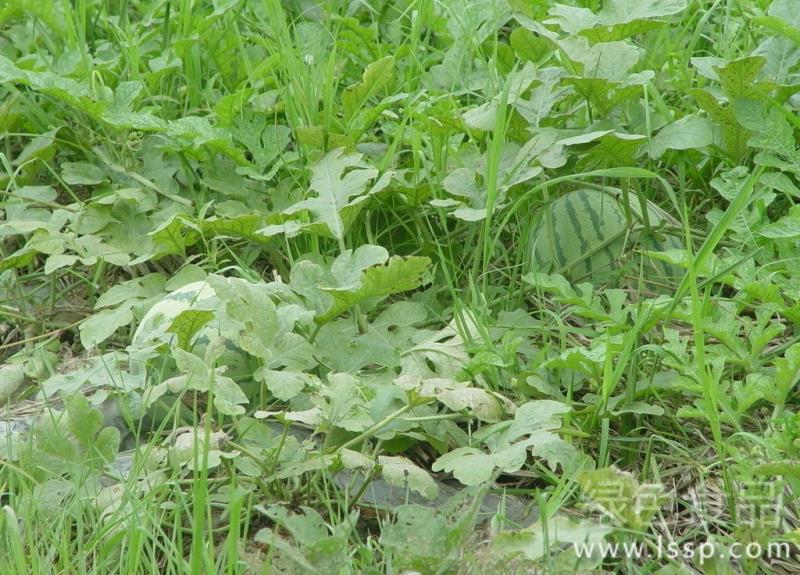
Watermelon field
Weed growth in watermelon fields has 2 peak periods. The 1st peak period occurs as watermelon seedlings emerge from the soil, and weeds at this stage account for 60% of the total weeds over the entire watermelon growth period; the 2nd peak period occurs when the watermelon vines grow to about 70cm.
First, plastic film mulching is recommended to reduce opportunities for weeds to emerge.
In addition, chemical herbicides can be used to remove weeds in watermelon fields. Herbicides for watermelon fields fall into two categories: non-selective and selective. Non-selective types effectively control all kinds of weeds, while selective types target a certain weed or a certain category of weeds. In the 1st peak period, before watermelon seedlings emerge, herbicides such as prometryn, simazine, naptalam, chlorpropham and amiprophos can be applied to treat the soil surface; in the 2nd weed outbreak peak period, selective herbicides such as haloxyfop, quizalofop-p-ethyl and fluazifop-p-butyl should be used. Applying these herbicides as a spray during the 2-5 leaf stage of grass weeds can control weeds and is safe for watermelon seedlings.
Herbicide application techniques
1. Non-selective herbicides: if used improperly, watermelon seedlings are prone to herbicide damage, and the suitable time for use is the period after watermelon sowing and before seedling emergence. For example, prometryn: after sowing and before seedling emergence, use 150-200 grams per mu of 50% prometryn wettable powder for surface spraying to control annual weeds. Simazine: before watermelon seedling emergence, use 150-200 grams per mu of 80% simazine wettable powder for surface spraying.
2. Selective herbicides. They are suitable for use during the watermelon growth period and will not cause herbicide damage. For example, haloxyfop, applied at the 2-5 leaf stage, can prevent and remove annual and a few perennial grass weeds. Use 65 milliliters per mu of 12.5% haloxyfop emulsifiable concentrate for stem and leaf spray treatment; the dosage must be doubled to prevent and remove perennial grasses. Fluazifop-p-butyl: it has control and removal effects on both annual and perennial grasses, but has no effect on broadleaf weeds. At the 2-5 leaf stage of grass weeds, use 70-130 milliliters per mu of 35% or 15% fluazifop-p-butyl emulsifiable concentrate for stem and leaf spraying. Quizalofop-p-ethyl: at the 2-5 leaf stage of grass weeds, carry out stem and leaf spraying; it acts quickly and has good results.