Improper fertilization of carrots can easily cause fertilizer damage; how can fertilization increase yield?
Carrots are rich in nutrients, containing carotene, sugars and mineral elements such as calcium, phosphorus and iron, and are known as "little ginseng." However, during cultivation, improper fertilization can cause split roots, hollow hearts, deformities, quality deterioration and a large amount of woody texture, so scientific and reasonable topdressing is very important for increasing carrot yield.
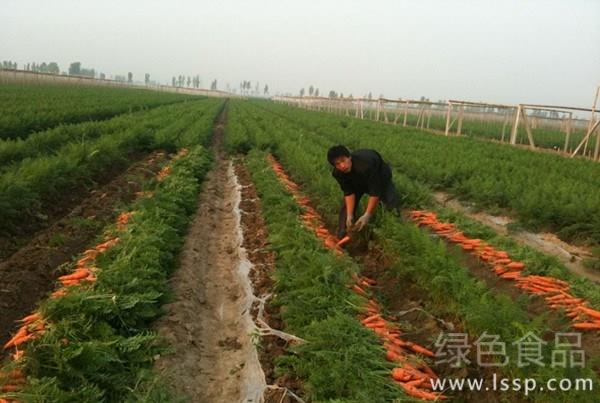
Carrot
I. Fertilizer requirement characteristics
Carrots have a high fertilizer requirement. Research shows that 1000 kg of carrots requires 2.4 kg of pure nitrogen, 0.8 kg of phosphorus pentoxide and 5.7 kg of potassium oxide.
Carrots at different growth and development stages also differ greatly in nutrient demand. Within two months after sowing, the absorption of various elements by carrots is not large. In the middle and late stages, as the carrot root begins to expand, growth increases rapidly and nutrient absorption also increases, with potassium absorbed in the largest amount, followed by nitrogen and phosphorus.
II. Fertilization techniques
1. Base fertilizer
Fertile and loose sandy loam soil is more suitable for carrots, whose roots go deep into the soil. Before sowing, deep plowing should be carried out and sufficient base fertilizer applied. Generally, 2000-2500 kg of decomposed organic fertilizer and 30-40 kg of Stanley compound fertilizer are applied per mu.
2. Topdressing
In addition to applying base fertilizer, topdressing should also be done 2-3 times. The first time is 20-25 days after carrot emergence, after 3-4 true leaves have grown, applying 5-10 kg of potassium sulfate compound fertilizer per mu. After carrot seedling thinning, carry out the second topdressing, using 10-15 kg of potassium sulfate compound fertilizer per mu. During the peak root expansion period of carrots, carry out the third topdressing, applying 15-20 kg of potassium sulfate compound fertilizer per mu.
3. Foliar fertilizer
Carrots have a high demand for boron. Spray once each at the seedling stage and the peak leaf growth stage, and spray 0.1%-0.5% boric acid solution or borax solution twice during the fleshy root expansion period.