The dragon fruit fruiting period is long; how should it be cultivated to achieve a higher yield?
Dragon fruit is a tropical and subtropical fruit. It is drought-tolerant, tolerant of high temperatures, and light-loving, with no strict requirements for soil quality. It can be planted on flat land, hillsides, and sandy-stony ground. The suitable soil pH is between 6 and 7.5, and it is best to choose land rich in organic matter with good drainage. Dragon fruit is not tolerant of frost; in areas where the winter temperature drops below 0°C, it can be grown in simple greenhouses.
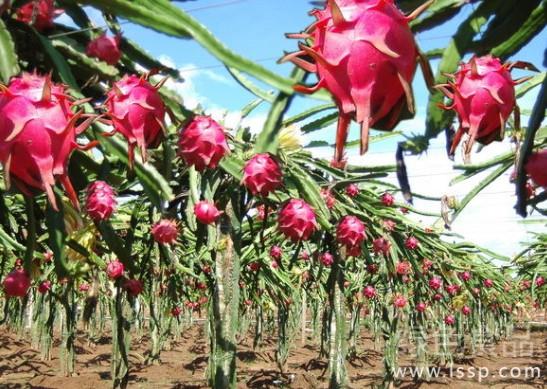
Dragon fruit
Planting methods.Dragon fruit can be grown climbing on walls or on trellises, but pillar cultivation is the most common, with low production costs and high land utilization. In so-called pillar cultivation, a cement pillar or wooden post is set in the middle of 3-4 dragon fruit seedlings, letting the dragon fruit grow upward along the pillar.
Planting specifications and double seasons.The row spacing of the pillars is 1.5m×2m. Calculating 4 dragon fruit seedlings planted around each pillar, 750 dragon fruit plants can be planted per mu. Dragon fruit can be planted in all four seasons. Be careful not to plant it too deep; planting it about 3cm deep is sufficient. Keep the soil moist in the early planting stage.
Field management.After planting, dragon fruit begins to flower and bear fruit 12-14 months later. It can flower 12-15 times per year, and the fruiting period of dragon fruit is from April to November. The fruit matures 30-40 days after the flowers fade, with a single fruit weight of 500-1000g. In the second year after planting, each pillar produces more than 20 dragon fruits, and in the third year it enters the full fruiting period of dragon fruit. With a higher level of management, the yield per mu can reach 2500kg. The key points for high-yield cultivation of dragon fruit are as follows:
1. Apply light fertilizer frequently:Because the harvest period is long, organic fertilizer must be applied heavily every year, and nitrogen, phosphorus, and potassium compound fertilizer must be applied in a balanced way over the long term. During the flowering and fruiting period of dragon fruit, supplement potassium and magnesium fertilizer to promote sugar accumulation in dragon fruit and improve quality. During the fruiting period of dragon fruit, keep the soil moist and cover the tree base with grass or mushroom residue. In dry weather, irrigate once every 3-4 days.
2. Pinching:When the branches grow to 1.3-1.4m long, pinch the tips to promote branching and let the dragon fruit branches droop naturally.
3. Interplanting and artificial pollination:When planting dragon fruit, interplant about 10% white-fleshed type dragon fruit. Interplanting allows mutual pollination, which can increase the fruit-setting rate. If rainy weather occurs, artificial pollination should be carried out. Artificial pollination can be done in the evening when the flowers are open or in the early morning before the flowers have closed, by directly applying pollen to the stigma of the female flower with a small brush.
4. Pruning branches:After each year's dragon fruit harvest, the branches that have already borne fruit should be cut off so that they can regrow new branches and ensure the next year's yield.
5. Pest and disease control:Dragon fruit has relatively few pests and diseases. The greatest threats at the seedling stage are snails and ants, which can be controlled with insecticides; in hot and humid seasons it is prone to diseases, with some branches becoming necrotic and developing mold spots, which can be controlled with strong copper oxide, triadimefon, and the like, with good results.