Kyoho grape quality has been declining year after year, how should management work be done?
In recent years, the quality of Kyoho grapes has declined, with poor ripening, uneven berry size, poor coloring, and firm, sour, astringent flesh; some fruit stalks turn brown, wither, and the grapes rot and spoil. Therefore, measures should be taken to improve the quality that Kyoho grapes ought to have.
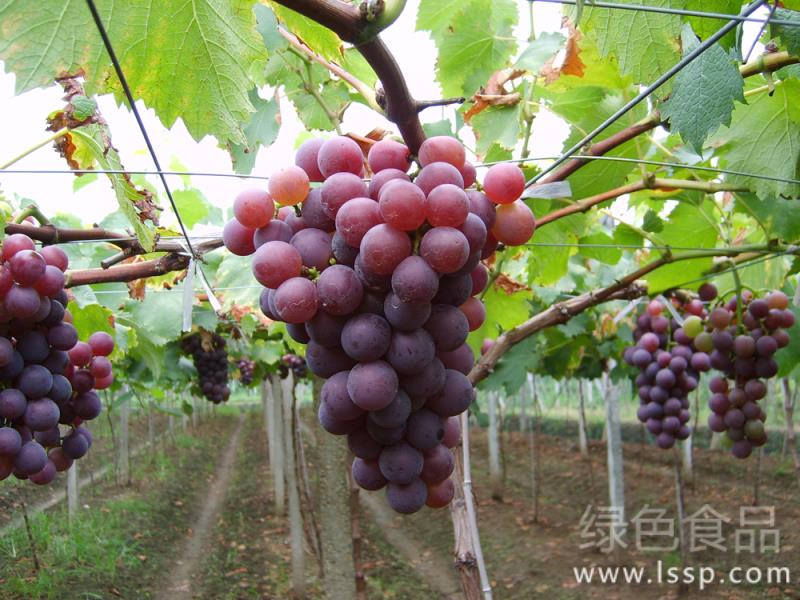
Kyoho grape
I. Strengthen fertilizer and water management
Kyoho grapes have high requirements for fertilizer and water. Usually, every 100 kg of berries harvested requires 1.5 kg of pure nitrogen, 1.0 kg of phosphorus, and 1.5 kg of potassium; at the same time, during the berry growth period, sufficient water can enlarge the berries and increase yield. However, if irrigation is excessive during the coloring to ripening stage of the grapes, the berries will have low sugar content, high acidity, poor coloring, and fruit cracking, and are prone to gray mold and late rot, affecting the color, aroma, and taste of the grapes and lowering their quality. Therefore, irrigation should be moderate, and in particular, watering must be stopped 15-20 days before grape harvest. Control the amount of nitrogen fertilizer, increase the application of phosphorus and potassium fertilizers, and prevent the grape plants from being overly vegetative and leggy, with dense branches and leaves, poor ventilation, and insufficient light, so that the grapes cannot grow and ripen normally, and the fruit stalks are crisp and tender, the skin is thin, and the resistance is poor. For this, during the coloring stage of the grapes, spray a 800-fold potassium dihydrogen phosphate solution on the leaves, and spray again half a month later, which can improve the quality of Kyoho grapes. After leaf fall in autumn, apply 2000-3 000 kg per mu of decomposed organic fertilizer with 2% phosphate fertilizer; at this time, the ground temperature is relatively high, which is conducive to the decomposition of organic fertilizer and the absorption and utilization of nutrients by the grape plant roots.
II. Reasonable pruning
In pursuit of high yield, flower clusters are not thinned in summer. Not pinching the tips of the clusters disperses the nutrient supply, making the grapes uneven in size and ripening. Light pruning and long leaving when winter pruning, leaving many branches and canes, causes the fruiting position of the grapes to move upward, making the clusters gather at the upper part of the trellis; due to excessive load and uneven distribution, nutrient imbalance occurs, and it is very difficult to form high-quality fruit. Therefore, for Kyoho grapes, the main shoot tips should be removed in time before flowering, and the secondary shoots should be removed, so that more nutrients can be transported to the flower organs; at the same time, some flower clusters should be properly thinned, and 3-5 days before flowering, the terminal 1/4-1/5 should be pinched off, so that nutrients can be concentratedly supplied to the remaining grapes. In winter pruning, use medium and long canes, leaving about 10-15 new shoots per square meter of trellis, staggered above and below, ensuring that each cluster of grapes has 15-25 leaves for growth, and the yield per mu of Kyoho grapes is controlled within 2500 kg. In this way, the clusters of Kyoho grapes can be compact, the berries uniform, and the ripening consistent, improving the flavor and color of the grapes.
grape
III. Prevention and control of diseases and insect pests
During winter pruning, thoroughly clean the vineyard and eliminate various pathogens. Before Kyoho grapes sprout in spring, to prevent powdery mildew and felt disease, spray 5 degrees Baume lime sulfur mixture; one week after flowering, to control black pox, spray an equal-amount 200-fold Bordeaux mixture; from early June, begin spraying 600-800-fold 50% thiram, once every 10-15 days, 3-4 times, and to prevent downy mildew, alternately spray 400-fold phosethyl aluminum; to prevent leafhoppers and other pests, spray 1000-1500-fold 40% dimethoate emulsifiable concentrate. If grape clearwing moths are found, pour 50% dichlorvos into the borer holes, then seal the insect holes with clay. To prevent market-bound grapes from being contaminated with pesticides, stop spraying pesticides half a month before harvest.
IV. Timely harvesting
The growth period of Kyoho grapes is 130-150 days, with an effective accumulated temperature of 3000°C-3200°C; coloring begins in early July, and they ripen in late August. Kyoho grapes belong to the medium-ripening category, and this variety is tetraploid.