Summer cabbage has good economic returns but is difficult to grow; how can high yields be achieved?
Summer cabbage is grown out of season and comes to market between summer and autumn, right during the vegetable off-season, so its economic returns are good. However, the germination and seedling stages of summer cabbage fall in the hot, rainy summer with long daylight hours, making it prone to pests and diseases and relatively difficult to cultivate. It often develops loose heads or fails to form heads at all, seriously affecting the yield and quality of summer cabbage. The key technical points for high-yield cultivation of summer cabbage are summarised here:
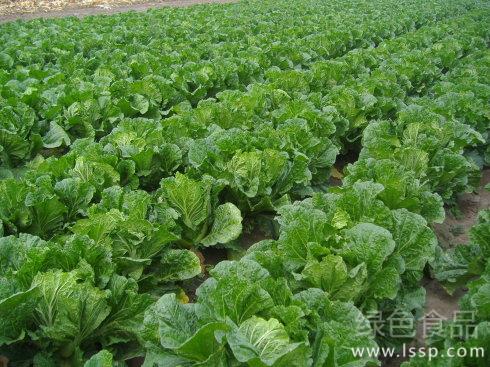
Summer cabbage
I. Select superior summer cabbage varieties.Varieties such as Kangre No. 45, Xiayang 50 and Zaoxinbai have a short growing period, form firm heads and have good quality. They are resistant to viral disease and soft rot, tolerant of downy mildew, and can still form heads normally at around 35, making them suitable for summer cultivation.
II. Land preparation and fertilisation.Summer cabbage grows vigorously and has a high demand for water and nutrients but does not tolerate waterlogging, so the cultivation method chosen is heavy basal fertilisation with high-ridge planting. Apply 3000-5000 kg of decomposed organic fertiliser, 75 kg of NPK compound fertiliser and 4-5 kg of methyl parathion per mu, mixed with 20 kg of superphosphate and 10 kg of zinc sulfate. After fertilising, prepare the land finely and form high ridges 80 cm wide and 15-20 cm high, with furrows 50 cm wide. To prevent pests and diseases, apply per mu 10 kg of fine soil mixed with 0.75 kg of thiophanate-methyl, applied at the base of the ridge.
III. Sowing method.Direct sowing can be done after June 1st; before that, seedlings can be raised in nutrient pots and transplanted as small seedlings. For direct sowing, dibbling can save seed, using 50 to 100 grams of Chinese cabbage seed per mu. The sowing density requires a row spacing of 40 cm and a plant spacing of 33-37 cm, planting 4500-5000 plants per mu. When sowing, plots with poor soil moisture must first be watered thoroughly to build up subsoil moisture before sowing.
IV. Field management.Summer cabbage has a short growth period, so a management approach of promoting growth all the way through is appropriate. During the seedling stage, thinning, final thinning and gap filling must be done promptly: thin for the first time at 3-4 leaves and establish the final stand at 5-6 leaves. Avoid damaging the roots when thinning and establishing the stand. Summer temperatures are high and soil moisture evaporates quickly, so water and loosen the soil in good time. In dry weather with no rain, apply a light watering every 2-3 days; on rainy days, drain accumulated water from the field promptly to prevent rotting of the seedling roots. Give summer cabbage a thorough watering 10-15 days before head formation, and cultivate and restrain growth. After the watering that restrains growth, apply a topdressing to strengthen head formation. During the head-forming stage of Chinese cabbage, keep the soil moisture up, focus on topdressing, and apply 10 kg of urea or 15 kg of ammonium phosphate by dibbling or furrow application together with watering; the fertiliser placement should be well away from the cabbage plants to avoid burning the roots. Stop watering 5-7 days before harvest.
V. Pest and disease control.Summer cabbage is prone to pests and diseases, so control them as soon as they are detected. Downy mildew and soft rot are the main diseases of summer cabbage. For downy mildew control, spray a 150 to 200 times dilution of 40% fosetyl-aluminium wettable powder or a 500 times dilution of 75% chlorothalonil wettable powder; for soft rot control, spray 100 to 150 mg/litre agricultural streptomycin. Spray about once every 7 days, for 2 to 3 consecutive sprays. Pests include aphids and cabbage caterpillars, which can be controlled with a 1000 to 1500 times dilution of 4.5% beta-cypermethrin.