What to Do About Low Fruit Set in Pomegranates? Methods to Protect Flowers and Fruits and Improve Fruit Set
May and June are the peak season when fruit pomegranate flowers bloom in abundance. Most pomegranate flowers are degenerate flowers, and normally only about 10% of the total pomegranate flowers are complete flowers capable of setting fruit. To promote fruit set, increase yield and improve quality, the following flower- and fruit-protecting measures can be taken in May and June:
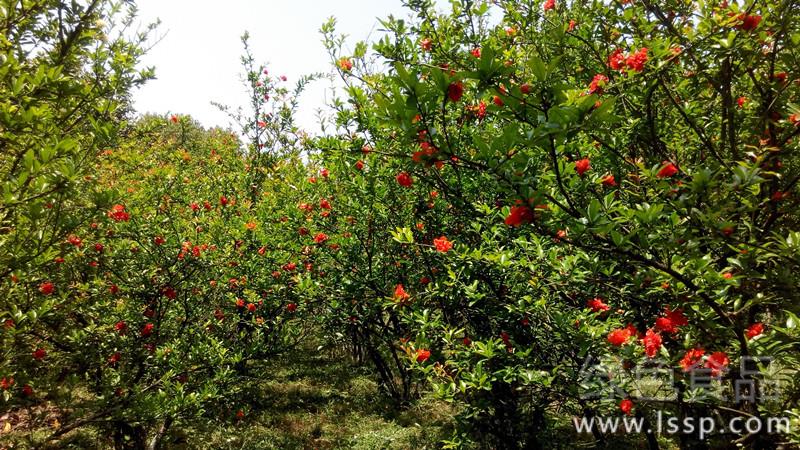
Pomegranate flowering stage
1. Foliar feeding.At the early flowering stage of pomegranate, foliar spraying with a 0.5% urea solution, 1% superphosphate extract, 0.3% monopotassium phosphate solution or 0.3% borax solution can increase the pomegranate fruit set rate by 7%-10%.
2. Flower and fruit thinning.Degenerate flowers that cannot set fruit normally consume large amounts of nutrients from the tree. Therefore, after the pomegranate buds appear and tubular flowers and bell-shaped flowers can be distinguished, most of the bell-shaped flowers that consume nutrients should be removed. After fruit set, promptly thin out diseased and insect-damaged fruits, deformed fruits, late-season fruits and the small fruits in clustered fruits. The amount of fruit thinning depends on tree vigor: thin more when there are many fruits and less when there are few; thin more on old and weak trees and less on vigorous trees. Practice has shown that the earlier and more thoroughly the flower buds are thinned, the more obvious the yield increase; fruit thinning can also make the pomegranates ripen uniformly, with large size and good quality.
3. Artificial supplementary pollination.Pomegranate has a low rate of self-pollination fruit set. When there is low temperature and rainy weather during the flowering period and few pollinating insects, artificial supplementary pollination can increase the pomegranate fruit set rate by 9.6%. The method is: when there are few trees and the amount of pollination needed is small, directly pollinate tubular flowers with newly opened bell-shaped flowers, or use a brush to first collect pollen from normal flowers of pollinator trees that have already shed pollen, then dab the pollen onto the stigmas of newly opened normal flowers of the main pomegranate trees; remove the petals of pollinated flowers as a marker. When the amount of pollination needed is large, first collect large numbers of excess buds and flowers from pollinator trees, remove the petals, take out the anthers, dry them in the shade so the anthers dehisce, then store them together with the husks in a desiccator in the refrigerator. When pollinating, dip a brush in the pollen and dab the flowers. The amount of pollination should be determined according to the tree: trees with a large canopy, strong vigor, and young trees and vigorous trees should be pollinated more to encourage more fruit set; pomegranate trees with a small canopy, weak vigor and old age can be pollinated less, so as to help restore tree vigor and improve pomegranate quality.
4. Timely prevention and control of pests and diseases.The main disease of pomegranate is dry rot, with a peak incidence in July; for control, a 1:1:160 Bordeaux mixture or an 800-fold 40% carbendazim suspension concentrate spray can be used. The main insect pests are the peach fruit borer and the peach fruit moth, both of which bore into the pomegranate as larvae to feed and cause damage, affecting pomegranate yield and quality. To control the peach fruit borer, during the peak period of adult emergence and egg laying, spray with a 1000-fold solution of 50% fenitrothion or 50% phoxim emulsifiable concentrate, or use 1 part 50% phoxim emulsifiable concentrate or 90% trichlorfon crystals plus 100 parts fine soil to make a pesticide paste and plug the calyx; to control the peach fruit moth, during the period when larvae emerge from the soil (June-July), spray the ground beneath the pomegranate canopy with a 300-fold solution of 50% phoxim emulsifiable concentrate, then shallowly hoe the tree basin, or during the peak emergence of adults, spray a 3000-fold solution of 2.5% deltamethrin or 20% fenvalerate.