Doing these things well during the young fruit stage of grapes makes yield and quality more assured
Currently we are in the young fruit stage of grapes. Whether management during the young fruit stage of grapes is proper affects the yield and quality of grapes that year. The management contents during the young fruit stage of grapes are:
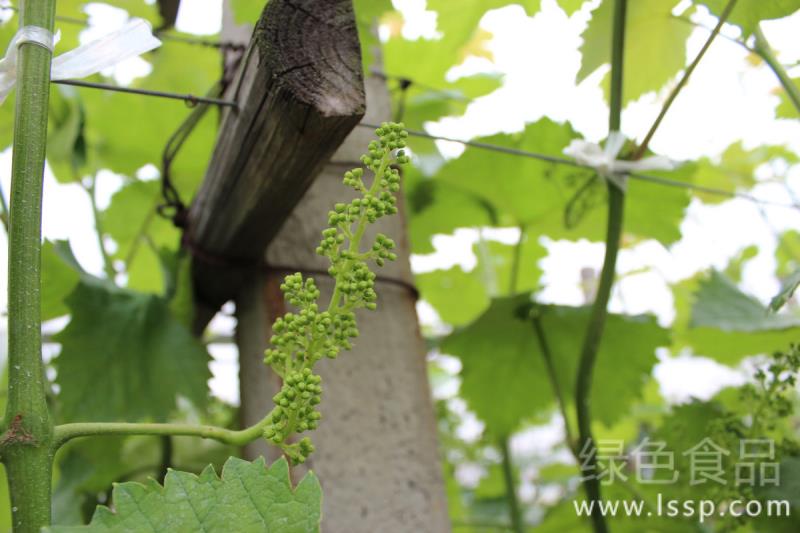
Young fruit stage of grapes
First, control yield and promptly remove clusters and thin fruit.
Trimming the fruit clusters first means thinning fruit clusters, generally carried out when grapes are the size of mung beans after petal fall. The main task is to remove fruit clusters on poorly set, diseased and weak branches, so that the ratio of fruiting branches to vegetative branches on each grapevine is controlled at 1.5:1. The second is thinning berries, usually done in two rounds. The first round is when grapes are the size of soybeans, combined with the work of thinning fruit clusters, removing deformed fruit and diseased fruit; the second round is before bagging the grapes, removing deformed fruit, small mummified fruit, diseased fruit and grapes in overly dense areas, to determine the final number of grapes per cluster.
Second, increase the application of organic fertilizer to improve grape quality.
When the young grapes are the size of soybeans, it is the critical period of fertilizer and water for grape development. For this topdressing, nitrogen fertilizer is the main type, combined with phosphorus and potassium. Apply 30 kg of urea, 20 kg of superphosphate, and 20 kg of potassium sulfate per mu. This topdressing should be combined with irrigation, and the irrigation should be thorough.
Grapes at the young fruit stage
Third, bag the fruit clusters to improve quality.
Bagging can effectively prevent grape diseases, bird damage and sunscald, and avoid contamination of grapes by pesticide residues. Before bagging, a broad-spectrum fungicide must be sprayed once for comprehensive disinfection, to reduce the incidence of disease in grape fruit clusters and increase the premium rate of grapes.
Fourth, prevention and control of pests and diseases.
The main diseases at the young fruit stage of grapes include gray mold, black pox, downy mildew, powdery mildew, etc. Pests include green plant bug, clearwing moth, spotted lanternfly, leafhopper, etc. In vineyards with a high incidence of grape anthracnose, the young fruit stage is also the key period for controlling anthracnose. It is not only necessary to "treat" but also to "prevent." Timely spraying of effective agents can ensure the normal growth and development of grapes.
Disease-control agents include 80% Daconil M-45, 25% pyrisoxazole, 50% boscalid water-dispersible granules, pyraclostrobin. metiram, 20% flumorph with 80% mancozeb, 80.0% tebuconazole, etc. Pest-control agents include 5% emamectin benzoate, beta-cypermethrin, 25% thiamethoxam, etc. If grape red spider mite damage occurs, use 15.0% pyridaben emulsifiable concentrate at 2000 times dilution, or 20.0% azocyclotin suspension concentrate at 1500 times dilution.
Notes: Grapes at the young fruit stage are relatively sensitive to agents, so it is recommended to use single agents as much as possible and choose to apply them after 4 p.m. to avoid phytotoxicity to grape fruit and leaves; in addition, when applying, spray the front and back sides of leaves evenly. Agents should be used alternately.